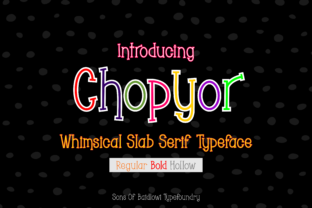
Chopyor
A Whimsical Slab Serif That Feels Like a Smile in Type
Imagine a font that doesn’t just say something—but winks while saying it. That’s Chopyor: a whimsical slab serif with rounded corners, gentle curves, and an unmistakably playful spirit. It’s not trying to be serious, but it’s never sloppy. It’s not childish—but it’s full of charm. Designed for moments when warmth, approachability, and visual delight matter as much as legibility, Chopyor brings personality to the page without sacrificing structure.
What Makes Chopyor Stand Out?
At first glance, Chopyor looks friendly—almost huggable. But look closer, and you’ll notice thoughtful craftsmanship:
- Soft slab serifs—thick, grounded strokes with subtly rounded ends that soften contrast without losing presence;
- Open counters and generous x-height, making it highly readable even at smaller sizes;
- Gentle asymmetry in letterforms like the lowercase a and g, adding organic rhythm—not rigid uniformity;
- Warm proportions—neither too condensed nor too extended—designed to breathe comfortably on screen and in print.
Unlike many playful fonts that lean heavily into cartoonish exaggeration, Chopyor balances quirk with quiet confidence. It’s the kind of typeface that feels at home on a handmade soap label *and* a boutique café’s digital menu—because its voice is consistent, not contradictory.
Who Finds Joy (and Utility) in Chopyor?
Chopyor isn’t a one-size-fits-all solution—but it *is* a perfect-fit solution for specific people and purposes. Here’s who tends to reach for it—and why:
- Creative entrepreneurs launching small brands—think candle makers, ceramic studios, or indie bookshops—who want their typography to reflect authenticity, care, and handmade warmth;
- Content creators building newsletters, Instagram carousels, or Substack headers where tone and recognition matter more than corporate neutrality;
- Educators and child-facing designers developing learning materials, classroom posters, or early-reader apps—where friendliness supports engagement without infantilizing;
- UX writers and product teams adding subtle humanity to microcopy—like empty-state messages (“Oops! Nothing here yet—let’s fix that!”) or onboarding prompts;
- Event planners and wedding designers crafting invitations, signage, and digital RSVPs that feel personal, joyful, and intentionally unpretentious.
Where Chopyor Shines—and Where It Pauses
Like any well-designed tool, Chopyor excels within its natural range—and invites thoughtful consideration outside it.
Strengths You Can Rely On
- Instant emotional resonance: In under two seconds, Chopyor signals “this is welcoming” and “you belong here.” That’s invaluable for building trust quickly.
- Strong visual hierarchy potential: Its bold weight holds up beautifully as display text, while its regular weight remains clear and legible in body copy—especially in short bursts (captions, labels, callouts).
- Print-friendly texture: The slight softness in stroke endings prevents harsh ink spread on uncoated paper—making it a smart pick for letterpress, risograph, or artisanal packaging.
- Distinctive yet accessible: It stands out in crowded feeds without alienating readers unfamiliar with typographic nuance. No decoding required.
Real-World Moments Chopyor Elevates
Consider these everyday scenarios—no design degree needed:
- A local bakery updates its Instagram Stories with daily specials: Chopyor’s bold weight makes “Honey-Lavender Scone — $4.50” pop against a photo of flaky pastry—without shouting.
- An online course creator uses Chopyor for section headers in their Notion syllabus—adding lightness and clarity between dense concepts like “How to Mix Watercolors” and “Your First Wash Technique.”
- A children’s museum designs a scavenger hunt map for ages 4–8: Chopyor’s open shapes and friendly rhythm help young readers recognize words like “dinosaur,” “mirror,” and “sound booth” faster—and with more confidence.
- A sustainable skincare brand prints ingredient lists on recycled kraft boxes: Chopyor’s warm weight and readability ensure transparency feels sincere—not clinical.
Things to Keep in Mind Before You Type “Chopyor” Into Your Design Tool
Chopyor is expressive by nature—which means intention matters. Ask yourself:
- Is this context open to personality? Government forms, legal disclaimers, or enterprise dashboards may need neutral authority over cheerful charm.
- What’s the reading environment? While Chopyor performs well on modern screens, very long paragraphs (e.g., blog posts over 800 words) benefit from pairing it with a highly legible companion font for body text—like a clean sans-serif or low-contrast serif.
- Does your brand voice have room for play? Chopyor won’t suit a luxury watchmaker aiming for timelessness through austerity—but it’s ideal for a vintage toy restorer who signs each box with “Played with love since 1972.”
- Are you using it consistently? Because Chopyor carries strong character, using it sparingly (e.g., only for headlines, logos, or CTAs) often has more impact than applying it universally across every UI element.
A Quick Suitability Checklist
Before committing, scan your project against these questions:
- ✅ Does your audience respond well to warmth, approachability, or lighthearted sophistication?
- ✅ Is your message enhanced—not distracted—by visible personality in the type?
- ✅ Do you need strong recognition at small sizes (e.g., app icons, favicons, social avatars)?
- ✅ Are you okay with a font that says “I’m thoughtful, not generic”—and are your stakeholders too?
- ❌ Is technical precision or extreme neutrality the top priority? (If yes, consider alternatives.)
Bringing Chopyor Into Your Workflow—Thoughtfully
You don’t need a full redesign to test Chopyor’s fit. Start small:
- Swap it in for your next email subject line—see if open rates shift (playful, specific subjects often do);
- Add it to one section of your website’s homepage—a testimonial banner, a feature headline, or a CTA button;
- Use it in a printed handout for your next workshop or community event—and ask attendees what feeling it evokes;
- Pair it with a simple, neutral font (like Inter or Lora) in a slide deck—let Chopyor handle titles and key phrases, while the other handles explanations.
Observe how people interact—not just how it looks. Does it slow them down? Make them smile? Feel more connected to your message? Those reactions are data points far richer than any trend report.
Final Thought: Typography With Heart
Chopyor reminds us that type isn’t just about transmitting information—it’s about transmitting feeling. In a world saturated with sleek minimalism and algorithm-driven sameness, choosing a font like Chopyor is a quiet act of human-centered design. It doesn’t solve complex problems alone—but it makes the spaces where those problems get solved feel safer, kinder, and more inviting. Whether you’re naming a new product, designing a birthday card, or reimagining your studio’s visual language, Chopyor offers something rare: clarity with kindness, structure with soul.
If your work values authenticity over automation, warmth over width, and charm over conformity—then Chopyor might just be the spark your next project has been waiting for.