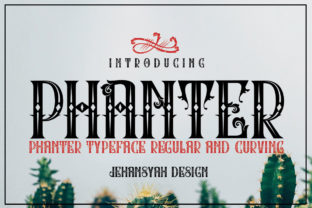
Phanter: A Strategic Choice for Impactful Visual Communication
Phanter is not just another display font. It’s a deliberate tool—designed with weight, contrast, and architectural confidence—that commands attention without shouting. Its bold serifs, tight spacing, and assertive letterforms make it ideal for moments where clarity, authority, and memorability intersect. For professionals who invest time in messaging—whether launching a brand identity, designing a keynote slide, or refining a product landing page—Phanter offers more than aesthetics. It offers intentionality.
Why Phanter Fits Real-World Strategy, Not Just Stylistic Preference
When you choose a typeface, you’re making a quiet but consequential decision about how your audience will interpret tone, credibility, and priority. Phanter communicates competence and conviction—not because it’s loud, but because its structure feels resolved and purpose-built. That matters when you’re positioning a premium service, introducing a thought leadership report, or anchoring a campaign around clarity and action.
Unlike decorative fonts that sacrifice legibility for flair, Phanter maintains strong readability at larger sizes—especially in controlled environments like hero sections, presentation titles, signage, or editorial headlines. Its strength lies in restraint: it doesn’t try to be everything. It excels where hierarchy needs reinforcement and where visual economy supports strategic focus.
Where Phanter Delivers Measurable Value
Consider these practical applications where Phanter contributes directly to outcomes:
- Brand Launches & Rebrands: When establishing a new identity—or reasserting an existing one—Phanter helps define voice before a single sentence is read. A logo lockup using Phanter signals stability and forward motion, especially when paired with a neutral sans-serif for body text.
- Keynote Presentations & Workshop Materials: In live or recorded talks, audiences process information faster when hierarchy is visually unambiguous. Phanter’s strong presence on title slides or section headers reduces cognitive load and keeps attention anchored to your core message—not the typography itself.
- Digital Campaign Assets: Banners, email headers, and social media cover images benefit from Phanter’s ability to scale well across devices while retaining impact. Its boldness translates effectively even in compressed formats, provided contrast and spacing are preserved.
- Educational & Publishing Contexts: For course modules, whitepapers, or newsletter headers, Phanter reinforces seriousness of intent. It subtly cues the reader that what follows has been curated—not aggregated—and deserves focused attention.
Using Phanter With Discipline, Not Default
Powerful tools require thoughtful handling. Phanter’s strength becomes a liability if applied without context or constraint. Its visual weight demands breathing room, clear contrast, and alignment with surrounding design decisions. Using it everywhere dilutes its effect—and risks undermining the very authority it conveys.
Ask yourself before applying Phanter:
- What specific outcome am I trying to support? Is it recognition? Trust? Urgency? If the goal is subtlety or warmth, Phanter may misalign—even if it looks “cool.”
- Does this use case allow for sufficient contrast and scale? Phanter performs poorly at small sizes or against busy backgrounds. It needs space and simplicity to land.
- Is there consistency in how I’m deploying it? Using Phanter for a headline, then switching to three unrelated fonts elsewhere fractures visual coherence. Pair it deliberately—typically with a clean, highly legible sans-serif (e.g., Inter, Lato, or Helvetica Neue) for supporting text.
- Does it reflect the audience’s expectations—or challenge them meaningfully? A financial advisory firm targeting retirees may find Phanter too assertive; the same font could energize a tech startup’s developer documentation by signaling precision and capability.
Risks of Unintentional Use
Without grounding in goals, Phanter can unintentionally communicate rigidity, impersonality, or even exclusion. Its formality isn’t inherently negative—but it does carry assumptions. A nonprofit using Phanter across all donor communications might inadvertently distance supporters who respond better to approachable, human-centered language and visuals. Similarly, educators integrating Phanter into student-facing materials risk signaling hierarchy over collaboration unless balanced with inclusive imagery and accessible layout choices.
Another common misstep: treating Phanter as a “fix” for weak content. No font compensates for vague value propositions, inconsistent messaging, or unclear calls to action. If your headline reads “Solutions for Everyone,” but lacks specificity, Phanter won’t add credibility—it’ll only spotlight the ambiguity.
Strategic Pairing and Practical Implementation
Phanter thrives in contrast—not competition. Its natural counterpart is a neutral, highly functional sans-serif. Avoid pairing it with other high-contrast or decorative fonts; the goal is resonance, not rivalry. Set Phanter at sizes no smaller than 32px for web headlines and 24pt for print, always testing legibility against your intended background.
In CSS, leverage variable font features if available (many modern Phanter releases include optical sizing and weight variants). Use font-weight: 700 or higher for maximum presence, and adjust letter-spacing slightly (0.5–1px) to prevent crowding in all-caps settings. Never stretch or skew the font—its integrity depends on native proportions.
For print projects, confirm that Phanter includes full OpenType support—especially for discretionary ligatures or stylistic alternates you may want to enable selectively. And always embed properly; fallbacks should preserve hierarchy (e.g., font-family: "Phanter", "Helvetica Neue", Arial, sans-serif;).
Long-Term Positioning and Evolution
Brands evolve. So should typographic choices—but not impulsively. If Phanter anchors your current visual system, document *why*: Which customer touchpoints does it serve best? What emotional response does it reliably trigger in user testing? How does it perform across cultures or languages you serve? These notes become invaluable during future audits or refresh cycles.
Also consider scalability. Does Phanter offer enough weights and widths to grow with your needs? A single-bold version limits flexibility; a full family (Light to Black, Condensed to Extended) supports nuanced expression without abandoning consistency. If your work spans multiple markets or mediums, prioritize versions with extended Latin, Cyrillic, or Greek character sets—especially if translation or localization is part of your roadmap.
Making the Decision Intentionally
Choosing Phanter shouldn’t be about trend-following or aesthetic instinct alone. It’s about recognizing when your goals demand visual authority, when your audience responds to confident framing, and when your content is strong enough to hold up under such deliberate emphasis.
Test it early—not just in mockups, but in real scenarios. Print a sample poster. Project a slide in a dim room. View a banner on a mobile device in daylight. Observe where it gains attention—and where it creates friction. Let those observations guide refinement, not assumptions.
Ultimately, Phanter earns its place when it serves strategy first and style second. It’s not for every project. But for the right moment—with the right message, the right audience, and the right execution—it transforms how something is seen, remembered, and acted upon.