Crescendo Font
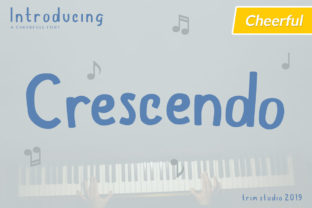
Crescendo is a display typeface designed for visual impact and expressive personality. It belongs to the decorative serif category, characterized by exaggerated proportions, playful stroke contrasts, and intentional irregularities—such as uneven baseline alignment, asymmetrical serifs, and slightly wobbly letterforms. These quirks are not flaws but deliberate design choices meant to evoke warmth, energy, and approachability. Crescendo is not intended for long-form reading or functional interfaces; rather, it serves best where typography must capture attention and convey tone quickly—think headlines, logos, posters, packaging, or short digital banners.
Why Consider Crescendo?
Designers and content creators often seek typefaces that reinforce brand voice without relying solely on imagery or color. Crescendo stands out in contexts where friendliness, creativity, or lighthearted confidence matters—particularly for audiences that respond well to human-centered, non-corporate aesthetics. Its distinct rhythm and organic feel can help differentiate a project from more predictable, geometric sans-serifs or neutral slab fonts. People exploring display fonts may be drawn to Crescendo when they need something memorable yet legible at larger sizes, and when their use case prioritizes emotional resonance over strict neutrality.
Key Benefits of Using Crescendo
- Strong visual identity: Its bold weight and expressive details make it instantly recognizable, supporting consistent branding across touchpoints.
- High readability at display sizes: Letters remain clear and distinguishable when used at 36pt and above, especially with sufficient spacing and contrast.
- Personality-driven versatility: Works across diverse creative domains—including children’s media, indie publishing, artisanal product labels, and event promotions—without requiring heavy stylistic adjustments.
- Good language support: Most releases include Latin-based character sets covering Western and Central European languages, making it suitable for multilingual projects within those regions.
Tradeoffs and Practical Considerations
Crescendo’s strengths come with limitations that affect usability. Its irregular forms reduce legibility in smaller sizes (below 24pt) and in low-resolution environments. Text set in Crescendo should avoid tight tracking or cramped line heights, as its inherent variation can cause visual crowding. It also lacks true italics or extensive optical sizing variants—meaning designers must rely on manual adjustments or complementary fonts for emphasis or hierarchy. Additionally, while many versions offer OpenType features like stylistic alternates or ligatures, support varies across platforms and applications; testing in target environments (e.g., web browsers, email clients, print workflows) is advisable before finalizing layouts.
When Crescendo Is a Strong Fit
Crescendo performs best in controlled, high-impact scenarios. It excels in branding for lifestyle startups, educational tools aimed at younger learners, boutique retail signage, or editorial features where headline tone sets the narrative mood. For example, a nonprofit campaign focused on community joy might use Crescendo for hero banners to signal openness and sincerity—especially when paired with warm photography and ample white space. Similarly, an illustrated cookbook targeting home cooks could use Crescendo for chapter titles to reinforce a handcrafted, inviting aesthetic. In all these cases, the font supports intent without competing with content.
When Alternatives May Be More Appropriate
If your project requires extended text blocks—even in headings—Crescendo may introduce fatigue or ambiguity. For instance, news sites, academic publications, or SaaS dashboards benefit more from highly legible, scalable type systems like Inter, Source Serif Pro, or IBM Plex Serif. Likewise, accessibility requirements—such as WCAG-compliant contrast and consistent letterform recognition—may limit Crescendo’s suitability for public-facing digital interfaces where users rely on screen readers or zoom functionality. Projects with strict typographic hierarchies (e.g., multi-tiered navigation menus or data-dense infographics) often require more predictable metrics and spacing behavior than Crescendo provides.
Making a Practical Decision
To determine whether Crescendo aligns with your goals, begin by clarifying your primary objective: Are you solving for recognition, emotion, or function? If recognition and emotion are central—and your usage is limited to large-scale, short-text applications—Crescendo warrants serious evaluation. Test it against real content: Set your actual headline or logo text, render it at intended sizes, and review it across devices and lighting conditions. Compare how it pairs with your existing palette and imagery. Does it enhance or distract? Does it feel authentic to the message?
Also consider technical constraints. Check licensing terms: Some Crescendo variants are free for personal use but require commercial licenses for client work or embedded web fonts. Verify file formats (WOFF2, OTF, TTF) match your delivery pipeline. If you anticipate needing multiple weights or condensed variants, confirm availability—many display fonts offer only one or two weights, limiting flexibility in responsive layouts.
Finally, reflect on audience expectations. A tech conference using Crescendo for its main stage banner may signal approachability, but the same font on a financial services landing page could unintentionally undermine perceptions of stability or precision. Context shapes interpretation—and Crescendo’s charm relies heavily on alignment between tone, medium, and viewer.
Comparing Within the Display Category
Crescendo occupies a specific niche among expressive display fonts. Unlike Bungee, which leans into retro-bold confidence, or Comic Neue, which mimics hand-drawn informality, Crescendo balances playfulness with structural coherence. It avoids extreme distortion while retaining enough uniqueness to stand apart from generic rounded serifs. Designers comparing options should assess not just appearance but rhythm, spacing behavior, and how each font handles real-world text strings—not just “Aa” specimens. Testing with words containing frequent ascenders/descenders (e.g., “flying,” “jazz,” “yell”) reveals how comfortably a font accommodates natural language flow.
In summary, Crescendo is a thoughtful choice when personality and presence matter most—and when its constraints fit naturally within your workflow and goals. It rewards intentionality: using it well means understanding where it shines, respecting its limits, and pairing it purposefully. For those evaluating display fonts with care, Crescendo offers a distinctive, human-scaled option worth exploring—but only where its bold, quirky voice serves the message, not overshadows it.