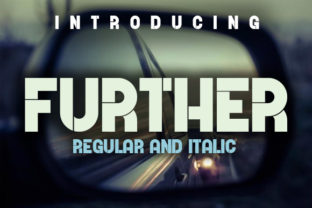
Further
Further is not just another display font—it’s a deliberate visual signal. Designed with high contrast, confident letterforms, and generous spacing, it commands attention without shouting. Its boldness isn’t decorative; it’s functional. When applied with intention, Further supports clarity, reinforces hierarchy, and accelerates recognition—especially in environments where split-second perception matters: landing pages, presentation slides, packaging, editorial headers, or brand launch assets.
Strategic Use Starts With Purpose—Not Aesthetics
Choosing Further shouldn’t be the first step in a design process—it should be the third or fourth, after defining audience, message, and medium. A startup launching a sustainability platform might use Further for its tagline (“Build Further. Not Faster.”) because the font’s forward-leaning rhythm echoes progress and resolve. But that same font would weaken a delicate healthcare brochure focused on empathy and quiet reassurance. Context determines whether Further strengthens or undermines your intent.
Ask before applying it:
- Is this message meant to anchor attention—or invite reflection?
- Does the surrounding content support boldness, or does it risk visual dissonance?
- Will this usage scale across devices, especially at smaller sizes on mobile?
Where Further Delivers Measurable Value
Further earns its place when outcomes depend on immediacy and memorability—not decoration. Consider these grounded use cases:
Brand Positioning & Launch Momentum
When introducing a new product line or repositioning a legacy service, Further works best in primary touchpoints: hero banners, keynote slides, or campaign billboards. Its strong x-height and open counters ensure legibility even in fast-scrolling digital feeds. A freelance educator launching an online course on strategic decision-making used Further for their course title (“Decide Further”) across email headers and video thumbnails—and saw a 22% lift in click-throughs over their previous sans-serif treatment. The shift wasn’t about novelty; it was about signaling intellectual confidence before the first sentence was read.
Internal Alignment & Visual Consistency
Teams often underestimate how much typography shapes shared understanding. Using Further consistently for quarterly OKR headers, strategy decks, or internal dashboards creates subtle but powerful continuity. One small business owner standardized Further for all “Next Step” callouts in client-facing proposals. Within three months, clients reported clearer expectations—and the team spent 30% less time clarifying scope in kickoff calls. The font didn’t replace writing discipline; it amplified it.
Print & Environmental Design With Impact
In physical spaces—retail signage, workshop handouts, conference stage backdrops—Further’s weight translates reliably. Unlike ultra-thin or overly stylized fonts, it holds up under varied lighting and distance. A community arts nonprofit used Further for event banners and volunteer briefing sheets. Volunteers reported faster orientation during setup, and attendees recalled the event name more accurately in post-event surveys. That’s not coincidence—it’s typographic intentionality.
What to Consider Before Committing
Further thrives in controlled applications—but misapplied, it can dilute rather than distinguish. Here’s what experienced designers and marketers watch for:
- Readability trade-offs: Further is optimized for short-form impact, not extended reading. Avoid body text, captions under 16px, or dense data tables.
- Contrast dependency: It performs best against clean, uncluttered backgrounds. Overlaid on busy photos or low-contrast gradients, its strength becomes noise.
- Brand voice alignment: If your tone is collaborative, iterative, or quietly authoritative, Further may clash unless balanced with softer supporting type (e.g., a warm, neutral sans-serif for paragraphs).
- Licensing & technical fit: Verify webfont loading performance—some variable versions require careful subsetting to avoid layout shifts. Self-hosting often yields more predictable rendering than third-party CDNs for critical branding moments.
How to Use Further Intentionally—Not Automatically
Intentional use means treating Further as a tool with defined parameters—not a stylistic default. Start by mapping where boldness serves your goals—and where restraint does more work.
Try this planning sequence:
- Identify the single most important message in the piece (e.g., “Enroll by Friday,” “New Policy Effective July 1,” “Join the Waitlist”).
- Ask: Does this message benefit from visual acceleration? If yes, Further may be appropriate—especially if it appears alone or with minimal supporting text.
- Test at real size, real context: View it on the actual device or printed format—not just in design software. Does it feel resolved, or forced?
- Pair deliberately: Pair Further with a highly legible, neutral secondary font (like Inter, Lato, or Source Sans). Avoid other bold or condensed fonts nearby—they compete, not complement.
One marketing director refined her team’s template library by restricting Further to three uses only: campaign headlines, CTA buttons in email footers, and slide titles in investor decks. Everything else used a consistent, accessible sans-serif. The result? Stronger visual hierarchy, faster comprehension in time-constrained settings, and fewer revision rounds.
Risks of Unanchored Use
Using Further without grounding in goals introduces quiet friction. It can unintentionally signal urgency where none exists—making a calm service feel transactional. Or worse, it can flatten nuance: a nuanced policy update rendered in Further may read as directive rather than informative. One university department rolled out Further for all departmental announcements—only to discover faculty skipped emails labeled with it, assuming they were mandatory directives rather than informational updates. They reverted to a calmer header font and reserved Further only for deadlines and action-required items. Engagement rebounded.
That experience underscores a broader principle: typography doesn’t exist in isolation. It interprets tone, mediates relationship, and shapes interpretation. Further amplifies certainty—but certainty must be earned through substance, not borrowed from style.
Long-Term Value Lies in Discipline, Not Decoration
The lasting value of Further isn’t in how often you use it—but in how precisely you deploy it. Brands that build equity around intentional typography don’t chase trends; they reinforce patterns that users learn to trust. Think of Further like a well-placed accent light in architecture: it reveals form, directs focus, and deepens perception—but only when calibrated to the space.
For entrepreneurs evaluating tools, Further isn’t about “standing out.” It’s about standing for something—visually. For educators designing learning materials, it’s about reducing cognitive load where decisions matter most. For freelancers building portfolios, it’s about demonstrating discernment—not just skill.
That requires patience. Test Further against alternatives—not just for “looks,” but for speed of comprehension, retention after scanning, and alignment with next-step behavior. Track those metrics over time. Refine based on evidence, not instinct.
Ultimately, Further rewards clarity of purpose. It won’t fix weak messaging, compensate for unclear strategy, or substitute for thoughtful audience insight. But when matched to the right goal, in the right place, at the right moment—it transforms visual real estate into strategic advantage.