Myth Spotty: A Star-Themed Display Font
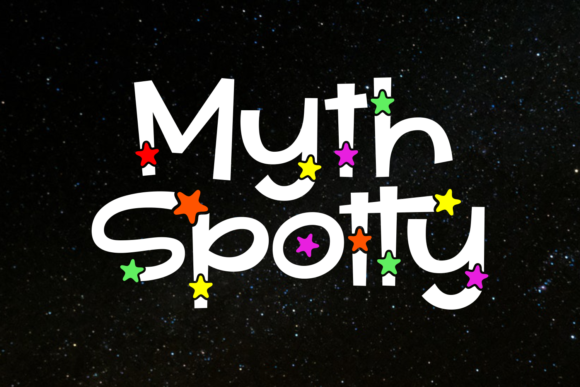
Myth Spotty isn’t just another decorative typeface—it’s a hand-crafted, star-themed display font built with meticulous attention to detail. Each glyph glimmers with subtle cosmic flourishes: tiny constellations dotting letterforms, delicate starbursts framing terminals, and gentle asymmetries that evoke the quiet magic of night skies. It’s not designed for body text or spreadsheets. Instead, Myth Spotty shines where personality, mood, and visual impact matter most—on posters, social banners, book covers, greeting cards, and digital announcements.
Why a Star-Themed Font Matters—Depending on Who You Are
What makes Myth Spotty meaningful shifts across roles and goals. For a freelance illustrator designing a children’s astronomy app, it’s about emotional resonance—using typography that feels wondrous and warm, not clinical or cold. For a small-batch candle maker launching a “Stardust & Sage” collection, it’s about brand voice: Myth Spotty helps signal playfulness and reverence in equal measure, without needing extra illustration. And for an educator preparing a classroom poster about the solar system? It’s a quiet teaching tool—students remember concepts more vividly when visuals carry consistent, joyful tone.
Beginners: Simplicity Meets Sparkle
If you’re new to design tools—or even just opening Canva or Google Slides for the first time—you’ll appreciate how Myth Spotty works without complexity. Install it once (as a desktop font) or load it via variable font support in modern platforms, then apply it like any other typeface. No layers, no masking, no plugins required. Its readability at large sizes means you won’t waste time adjusting kerning or tracking just to make it legible. Try pairing it with a clean sans-serif like Inter or Open Sans for contrast—your headline pops, your supporting text stays clear.
Designers & Creatives: Detail That Rewards Close Looking
Experienced designers notice what others don’t: how the “o” in Myth Spotty contains a faint orbit line; how the crossbar of the “t” ends in a miniature comet tail; how lowercase “a” and “e” have soft, nebula-like counters. These aren’t gimmicks—they’re intentional cues that invite pause and engagement. When used sparingly—on a single word in a logo lockup, as a chapter title in an illustrated zine, or animated frame-by-frame in a short video intro—Myth Spotty adds narrative weight. It doesn’t shout. It whispers *look closer*.
Educators & Content Creators: Making Learning Feel Light
In classrooms or online courses, typography shapes attention. Myth Spotty’s warmth lowers perceived difficulty—especially for topics students often find intimidating, like space science or mythology. A middle school teacher might use it for vocabulary wall cards (“Nebula,” “Orion,” “Celestial”). A podcast host launching a series on ancient star lore could feature it in episode thumbnails—not to distract, but to anchor each topic in a consistent, inviting visual language. The font doesn’t replace explanation, but it does make the first impression feel generous, not daunting.
Small Business Owners & Marketers: Standing Out Without Overdesigning
When your budget limits custom illustration or motion work, thoughtful typography becomes your strongest differentiator. Myth Spotty gives boutique brands—think indie bookshops, artisanal tea labels, or wellness studios—a way to communicate care and imagination without relying on stock graphics. One café owner used it for their seasonal “Milky Way Mocha” menu board; customers commented not just on the drink, but on how the name *felt* special. That’s Myth Spotty working quietly in service of authenticity—not trend-chasing.
What to Consider Before You Use It
Like any expressive font, Myth Spotty serves best when matched thoughtfully to context. Ask yourself:
- Is this for display—or delivery? It excels at headlines, logos, and short phrases (5–7 words max). Avoid long paragraphs, data tables, or legal disclaimers.
- Does my audience connect with wonder over precision? It suits creative, spiritual, educational, or nostalgic contexts—but may feel mismatched for fintech dashboards or medical device manuals.
- Do I need broad language support? Myth Spotty currently covers Latin-based languages (English, Spanish, French, German, etc.) with standard diacritics. It doesn’t include Cyrillic, Arabic, or extended Asian character sets.
- How will it render across devices? Tested well on macOS, Windows, and iOS, it performs reliably in print and static web use. For dynamic web environments (like user-generated text fields), pair it with a robust fallback stack—e.g.,
font-family: "Myth Spotty", "Comic Neue", cursive;
Real Projects, Real Decisions
A hobbyist making handmade galaxy-themed stationery chose Myth Spotty for envelope liners—not because it was “trendy,” but because its fine details survived inkjet printing at 12 pt. A university communications team used it in a limited-run poster series celebrating women in astrophysics, pairing it with archival photography to balance whimsy and gravitas. A children’s author testing cover options found readers consistently described the Myth Spotty version as “friendly” and “curious”—while the same layout in a geometric sans felt “smart but distant.”
None of these users needed Myth Spotty to solve every design challenge. They needed one reliable, expressive tool—one that added joy without demanding expertise.
Does Myth Spotty Fit Your Next Project?
It likely does—if your goal is to invite attention, suggest possibility, or soften formality with sincerity. It’s not for everything. But for the right moment—a launch announcement, a gift tag, a workshop title slide, a chapter opener—it carries weight far beyond its visual size.
You don’t need advanced skills to begin. You don’t need a big budget. You do need a project where tone matters as much as text—and where a little stardust, applied with intention, makes the difference between seen and remembered.