Hantleth: Bold Vintage Display Font
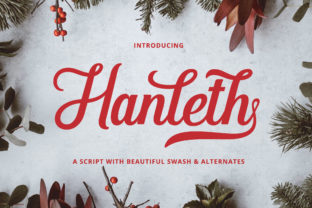
There’s a reason certain typefaces stop you mid-scroll—Hantleth is one of them. It’s not just bold; it’s unapologetically present. With thick, confident strokes and subtle vintage texture baked into its curves and serifs, Hantleth carries the warmth of hand-painted signage and the clarity of modern design sensibility. It’s a display font built for impact—not decoration.
What Makes Hantleth Stand Out
Hantleth isn’t trying to be everything. It’s designed for moments that demand attention: headlines, logos, posters, packaging, and hero sections. Its standout traits are intentional and functional:
- High visual weight—ideal for small-scale use (like social thumbnails) without losing legibility;
- Gentle irregularity—a hint of organic variation in stroke contrast and terminal shape, evoking letterpress or brushwork without sacrificing polish;
- Strong x-height and open counters—making even tight spacing feel breathable and readable;
- Vintage tone without cliché—no distressed edges or forced “retro” gimmicks, just thoughtful proportion and rhythm rooted in early-20th-century American display typography.
This balance—between strength and subtlety, nostalgia and usability—is why designers reach for Hantleth when they need personality *and* professionalism in one typeface.
Creative Uses That Actually Work
Great fonts spark ideas—but only if those ideas translate into real projects. Here’s how people are using Hantleth with intention:
For Branding & Identity
A local bakery in Portland uses Hantleth for its logo and menu headers. The font’s warmth reinforces their handmade ethos, while its boldness ensures visibility on aprons, chalkboard signs, and Instagram Stories. Key tip: Pair it with a clean, neutral sans-serif (like Inter or Lato) for body text—this contrast keeps messaging clear without diluting Hantleth’s character.
In Editorial & Publishing
An independent literary magazine uses Hantleth for section titles and contributor spotlights. Because it scales well from print to web, they apply it consistently across PDF issues, newsletter headers, and their Substack banner—always at 36–48px for digital, 24–30pt for print. They avoid using it for body copy (obviously), but do occasionally set pull quotes in Hantleth at 18px with generous line height—creating focal points without overwhelming readers.
For Social & Digital Marketing
A sustainable apparel brand overlays Hantleth on product photos for Instagram carousels. They stick to uppercase settings and limit each image to one line—“REPAIR NOT REPLACE”—keeping focus sharp. On TikTok thumbnails, they use Hantleth at 72px with a subtle drop shadow to ensure readability on mobile. No animation, no gradients—just strong, grounded typography doing its job.
Who Benefits—and How to Adapt It Thoughtfully
Hantleth serves different goals depending on your role—and your audience. Here’s how to match the font to your intent:
- Freelancers & small studios: Use Hantleth as a signature element in proposals and pitch decks—not everywhere, but on cover slides and service headers. It signals confidence without shouting. Keep color palettes restrained (e.g., charcoal + cream, or deep navy + warm sand) to let the type breathe.
- Educators & course creators: Apply Hantleth to module titles in online learning platforms (Thinkific, Teachable). Its boldness helps learners scan structure quickly. Avoid animated transitions or rotating effects—clarity trumps flair in instructional contexts.
- Bloggers & content creators: Reserve Hantleth for article titles and featured quote graphics. Skip using it in email subject lines (rendering inconsistencies across clients) or long-form blog headers where screen reader compatibility matters more than style.
- Small business owners: If you’re designing your own signage or packaging, test Hantleth at actual size before printing. Its thickness works beautifully on matte cardstock or kraft paper—but can feel heavy on glossy surfaces unless balanced with ample white space.
Practical Tips for Consistent, Effective Use
Even expressive fonts need boundaries. Here’s what keeps Hantleth working—instead of wearing out its welcome:
- Limit usage to one primary role per project. Is it your logo font? Your headline font? Your poster anchor? Pick one, then build hierarchy around it.
- Respect spacing. Hantleth needs room. Increase letter-spacing by +20–40 units in design software when used at large sizes. Tight tracking kills its rhythm.
- Test contrast rigorously. On dark backgrounds, use pure white or near-white (e.g., #f9f9f9). On light backgrounds, avoid pale grays—stick to true black (#000) or deep charcoal (#1a1a1a).
- Check platform rendering. On websites, serve Hantleth via variable-weight web font files (WOFF2) with fallbacks. Never rely solely on system fonts or image-based text for accessibility or SEO.
- Stay original—don’t imitate. You don’t need to add faux texture or overlay grain. Hantleth already carries its own voice. Let it speak plainly.
When Not to Use Hantleth
Knowing its limits is part of using Hantleth well. Avoid it for:
- Long paragraphs or interface labels (buttons, form fields, navigation menus);
- Brands aiming for minimalist, tech-forward, or clinical aesthetics (think SaaS dashboards or medical device interfaces);
- Situations requiring multilingual support beyond Latin-based scripts—Hantleth currently supports English, Spanish, French, German, and a few other Western European languages, but not extended Cyrillic, Arabic, or East Asian character sets;
- Accessibility-critical documents where WCAG AA/AAA compliance depends on highly legible, low-contrast body type.
That’s not a flaw—it’s focus. Hantleth was made to command attention, not blend in. Use it where impact matters most, and step back where clarity and function come first.
Final Thought: Typography as Quiet Confidence
Hantleth doesn’t beg for attention—it earns it. That’s rare. In a landscape full of flashy, overdesigned fonts, Hantleth stands out by being both strong and sincere. Whether you’re launching a new product, redesigning a website, or crafting a workshop handout, choosing Hantleth says: I value presence over noise, character over trend, and clarity over clutter.
So go ahead—set a headline. Print a poster. Design a logo lockup. Just remember: let the font do the work. You’ve got something worth showing off.