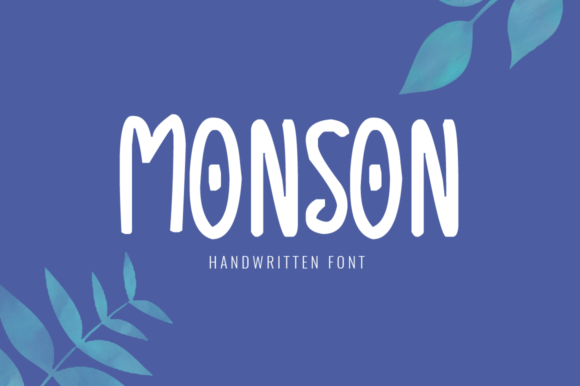
Monson: Where Handcrafted Warmth Meets Modern Design Clarity
Typography is rarely just about legibility—it’s about resonance. When a font carries intention, rhythm, and quiet confidence, it doesn’t merely label content; it shapes how that content is received, remembered, and trusted. Monson stands apart in this landscape not by shouting, but by leaning in—offering a rare balance of approachability and authority. Designed with deliberate looseness and subtle irregularity, Monson is a display font rooted in human gesture: the slight tilt of a pen stroke, the gentle variation in letter weight, the warmth of ink on textured paper. It isn’t “handwritten,” but it feels *lived-in*—a quality increasingly valued across digital interfaces, print publications, branding systems, and educational materials.
The Quiet Intelligence Behind Monson’s Casual Charm
What makes Monson feel both effortless and intentional lies in its thoughtful constraints. Unlike many script or brush-inspired fonts that rely on dramatic flourishes or exaggerated connections, Monson uses restraint as a design strategy. Its lowercase a, g, and y feature open, uncluttered forms—no tight loops or forced ligatures. The terminals taper softly rather than snapping sharply. Letter spacing is generous but never airy, encouraging readability even at moderate sizes. Capital letters retain a grounded presence, avoiding the theatricality that can undermine credibility in professional contexts.
This measured informality stems from careful observation—not of calligraphy manuals, but of real-world writing: chalkboard notes in a university seminar, handwritten labels on artisanal product packaging, margin annotations in a researcher’s field journal. Monson translates those organic gestures into scalable, consistent glyphs without sacrificing nuance. Its optical sizing is refined, meaning that at 36pt on a hero banner or 24pt in a slide title, the contrast and rhythm remain harmonious—not stretched, not flattened, but faithfully expressive.
Where Monson Adds Meaningful Distinction
Display fonts serve a critical functional role: they signal hierarchy, set tone, and invite attention. Monson excels precisely where personality must coexist with professionalism—environments where cold neutrality feels alienating, and excessive decoration feels untrustworthy.
- Educational platforms: Course titles, module headers, and learning pathway cards benefit from Monson’s inviting cadence. A biology course titled “Patterns in Pollination” set in Monson feels more like an invitation to explore than a mandate to memorize. In contrast, dense academic journals or data-heavy research dashboards typically reserve Monson for section dividers or thematic headings—not body text—preserving scannability while reinforcing conceptual framing.
- Local and values-driven brands: Cafés, independent bookshops, craft studios, and community health initiatives often choose Monson for signage, menus, and social media graphics. Its warmth communicates care without cliché; its clarity avoids the vagueness of overly decorative alternatives. A neighborhood library’s summer reading program poster gains immediacy when the headline “Stories That Stick With You” appears in Monson—friendly, memorable, and quietly confident.
- Digital product interfaces: While Monson isn’t intended for UI body copy, it finds elegant utility in onboarding screens, empty-state illustrations (“No projects yet—start your first one!”), and campaign landing pages. Its distinct voice helps users orient emotionally before engaging functionally. Notably, designers report improved engagement metrics when Monson headlines accompany empathetic microcopy—suggesting the font subtly reinforces tone alignment between visual and verbal language.
- Creative portfolios and personal websites: For illustrators, photographers, educators, and researchers building online presence, Monson offers typographic authenticity. It signals individuality without sacrificing polish—ideal for site titles, project category labels, or quote highlights. One documentary photographer uses Monson exclusively for caption typography in her online archive, noting how its gentle rhythm mirrors the contemplative pace of her image sequencing.
Practical Considerations for Thoughtful Implementation
Like any expressive tool, Monson reveals its full value only when paired with intention—not just aesthetic preference. Several considerations help ensure it enhances rather than distracts:
Pairing with Supporting Typefaces
Monson thrives alongside typefaces that offer structural counterpoint. Neutral sans-serifs—such as Inter, IBM Plex Sans, or Source Sans Pro—provide clean, highly legible body text that lets Monson’s character shine without competition. Avoid pairing with other display fonts, especially those sharing similar x-heights or stroke modulation; visual tension should arise from purposeful contrast, not accidental clutter. For print layouts, a warm-textured serif like Merriweather or PT Serif can create rich tonal layering—Monson for section openers, the serif for narrative depth.
Color and Contrast Strategy
Monson’s open forms and soft terminals respond gracefully to color, but saturation matters. Deep navy, charcoal, or forest green often ground its warmth more effectively than stark black—reducing visual weight while preserving authority. On light backgrounds, avoid pale greys (#E0E0E0) for Monson text; its delicate terminals can blur. Instead, use mid-tone greys (#5A5A5A) or rich, accessible darks. For accessibility compliance, always verify contrast ratios—Monson’s lighter weights require particular attention at smaller sizes.
Responsive Behavior and Technical Integration
Monson performs reliably across modern browsers and supports OpenType features including stylistic alternates (e.g., a more upright t or simplified f) and discretionary ligatures. When embedding via web font services, prioritize font-display: swap to prevent invisible text during load. On mobile, test headline rendering at 28–32pt: Monson’s generous spacing ensures legibility even with touch-target constraints. SVG export remains ideal for logos or icon-label combinations requiring pixel-perfect fidelity.
Why Monson Resonates Beyond Aesthetics
In an era saturated with algorithmically optimized visuals and templated layouts, Monson represents something rarer: a typeface designed for human perception, not machine parsing. Its success isn’t measured in download counts, but in how often users pause—not because they’re confused, but because the typography quietly affirms their presence. Teachers report students recalling slide titles set in Monson more readily than those in standard system fonts. Small business owners note customers describing their brand as “thoughtful” or “welcoming” after rebranding with Monson-led typography—even when logo and imagery remained unchanged.
This effect emerges from cognitive ease: Monson’s familiar-yet-distinct forms reduce processing load. Our brains recognize the rhythm of natural handwriting, even when abstracted into digital form. That recognition triggers subtle positive affect—making information feel more approachable, ideas feel more digestible, and voices feel more authentically human. It’s why Monson appears with increasing frequency in civic design projects—from public health campaign posters in multilingual neighborhoods to accessibility guides for aging populations. Its clarity isn’t clinical; it’s compassionate.
Looking Ahead: Monson in Evolving Contexts
As design systems mature and cross-platform consistency becomes non-negotiable, Monson’s adaptability proves valuable. Variable font versions—though not yet released—would allow fine-tuned optical adjustments across device classes: slightly tighter tracking for narrow mobile viewports, enhanced stroke contrast for low-resolution kiosks, or expanded width for expansive digital billboards. Designers experimenting with generative typography are already using Monson’s glyph structure as input for subtle animation sequences—letterforms gently rotating or shifting hue on scroll, reinforcing narrative flow without overwhelming content.
More significantly, Monson reflects a broader shift in typographic values: away from universality-as-erasure and toward specificity-as-service. It doesn’t try to be everything to everyone. Instead, it serves particular moments—those requiring warmth without whimsy, distinction without distance, and clarity without coldness. Whether anchoring a nonprofit’s annual impact report, introducing a new open-access journal, or labeling specimens in a university herbarium, Monson functions not as decoration, but as contextual intelligence made visible.
Final Reflection: Typography as Silent Stewardship
Great display typography does more than attract the eye—it prepares the mind. Monson achieves this by honoring two simultaneous truths: that communication is deeply human, and that clarity is an act of respect. It asks no one to decode its intent; instead, it extends quiet assurance through form. For professionals shaping experiences, educators framing knowledge, creators expressing vision, and organizations building trust, Monson offers not just a stylistic choice—but a subtle, consistent commitment to making meaning feel possible, personal, and worth returning to.