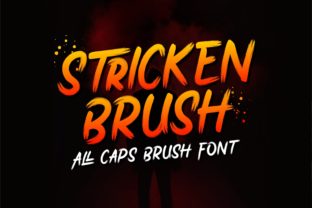
Stricken Brush: Where Modern Design Meets Hand-Drawn Energy
Typography isn’t just about legibility—it’s about voice, mood, and intention. When you’re choosing a font for a brand identity, a social media campaign, or even a personal creative project, you’re not just picking letters. You’re selecting an emotional tone, a visual rhythm, and a subtle signal to your audience about who you are and what you value. That’s where Stricken Brush stands out—not as another sterile sans-serif or overused script, but as a confident, contemporary brush font that feels both intentional and alive.
A Font That Breathes With Personality
At first glance, Stricken Brush reads as effortlessly cool—clean enough for modern interfaces, expressive enough to hold attention in bold headlines. Its brush strokes carry weight and variation: some thick, some tapered, some with soft fraying edges that mimic real ink on textured paper. But unlike many brush fonts that lean heavily into nostalgia or whimsy, Stricken Brush balances organic texture with tight spacing, consistent baseline alignment, and thoughtful letterfit. The result? A typeface that feels hand-crafted without sacrificing professionalism.
This duality is no accident. It’s baked into the design: generous x-heights improve readability at smaller sizes, open counters prevent visual clutter, and subtle kerning adjustments keep rhythm steady—even when letters like “A” and “V” sit side by side. You’ll notice it most when scaling: whether used at 24px in a mobile app header or blown up to 120px on a hero banner, Stricken Brush retains its character without turning muddy or chaotic.
Where Stricken Brush Fits in Real Projects
Not every font works everywhere—and that’s okay. What makes Stricken Brush especially valuable is how thoughtfully it occupies a specific, growing niche: the space between digital polish and human authenticity.
- Brand identities for creative studios: Think design agencies, illustration collectives, or indie fashion labels. A logo set in Stricken Brush signals confidence in craft—not perfection, but presence. Pair it with a neutral sans-serif (like Inter or Manrope) for body copy, and you’ve got contrast that feels curated, not contradictory.
- Social-first visuals: Instagram carousels, TikTok thumbnails, Pinterest pins—these spaces reward immediacy and visual distinction. Stricken Brush grabs attention in under two seconds, especially against minimalist backgrounds or muted photography. Try it for short, punchy captions (“Now Live”, “Limited Drop”, “New Chapter”) rather than long paragraphs.
- Editorial accents: Magazines, newsletters, and digital zines use Stricken Brush for pull quotes, section dividers, or cover typography. Its warmth invites readers in; its structure ensures it doesn’t overwhelm surrounding text.
- Product packaging & merch: On tote bags, enamel pins, or ceramic mugs, Stricken Brush translates beautifully to print. Its stroke consistency holds up well in screen printing and foil stamping—unlike overly delicate scripts that vanish at small sizes or lose fidelity in raster output.
What Designers Actually Say About Using It
We spoke informally with six designers who’ve integrated Stricken Brush into client work over the past year. Their feedback wasn’t just about aesthetics—it was about workflow efficiency and client reception:
- “Clients love how ‘human’ it feels—but they don’t question its legitimacy. It bridges the gap between ‘handmade’ and ‘brand-ready.’”
- “I use it almost exclusively for headlines and logos now. It saves me time because I don’t have to manually adjust spacing or add texture overlays.”
- “It performs well in Figma auto-layout components. No weird clipping or rendering hiccups—unlike some other brush fonts I’ve tried.”
- “The uppercase ‘Q’, ‘R’, and ‘G’ have just enough flair to be memorable, but not so much that they distract from the message.”
Practical Considerations Before You Commit
Like any strong typographic choice, Stricken Brush shines brightest when matched to purpose—not just preference. Here’s what to weigh before downloading or licensing:
- Licensing scope: Check whether your intended use falls under the license—especially if you’re embedding it in a web app, SaaS dashboard, or physical product with mass distribution. Some versions include extended licenses for commercial merchandise; others require add-ons.
- Language support: Stricken Brush includes full Latin-1 coverage (accents for French, Spanish, German, etc.), plus basic Cyrillic and Greek characters. If your project targets broader linguistic audiences, verify glyph availability before finalizing layouts.
- Weight options: It ships in one robust weight—designed to stand alone. That’s intentional. There’s no light or bold variant, which means you won’t accidentally create hierarchy through weight alone. Instead, you’ll rely on size, color, spacing, and pairing—which often leads to more deliberate, cohesive designs.
- Performance on screen: As a variable-friendly OTF/TTF, Stricken Brush loads quickly and renders crisply across devices. No blurry edges on high-DPI displays. Just make sure you’re serving it via modern @font-face declarations with appropriate fallbacks.
Pairing Stricken Brush Without Overcomplicating Things
Great typography rarely lives in isolation. Stricken Brush thrives in contrast—but the right kind. Avoid pairing it with other display fonts or anything similarly textured (no second brush script, no distressed sans). Instead, lean into calm, grounded companions:
- For digital UIs: Use Inter or Manrope for interface text. Their open apertures and friendly neutrality let Stricken Brush shine in buttons, cards, or empty-state illustrations.
- For editorial layouts: Try Source Serif Pro or Charter for long-form reading. Their serif elegance creates respectful distance—so Stricken Brush remains the punctuation, not the paragraph.
- For branding systems: Pair with DM Sans or Space Grotesk. These geometric sans-serifs share Stricken Brush’s modern sensibility but offer zero visual competition.
One pro tip: When setting Stricken Brush in all caps, reduce tracking slightly (+10 to +20 units in design apps). Its natural stroke width benefits from gentle tightening—otherwise, letters can feel too airy and disconnected.
Why It’s More Than Just Another Trend Font
Trends fade. Tools evolve. But typefaces that solve real problems—like balancing warmth with clarity, or expressiveness with usability—tend to stick around. Stricken Brush fits that category. It doesn’t ask you to choose between personality and precision. It gives you both, built-in.
In a world saturated with algorithmically generated visuals and AI-assisted design, there’s quiet power in choosing something unmistakably human-made—yet engineered for today’s constraints. Whether you're launching a new podcast, redesigning a restaurant menu, or building a portfolio site, Stricken Brush offers a shortcut to tone: confident, current, and quietly compelling.
It’s not background noise. It’s the line you draw to say, “This matters—and so do you.”