Amazle: A Bold Handwritten Display Font for Impactful Design
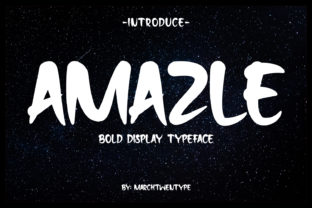
Amazle is a handwritten display font designed for visual impact. It features strong, expressive letterforms with deliberate irregularities, generous spacing, and confident stroke contrast. Unlike script fonts intended for extended reading, Amazle is optimized for short-form use—headlines, logos, posters, packaging, and digital banners where personality and memorability matter more than paragraph-level legibility.
People often explore fonts like Amazle when they need to differentiate a brand or message in visually saturated environments. Its distinct character makes it relevant for designers working on identity systems, social media creatives, event promotions, or product labels where standing out is a functional requirement—not just an aesthetic preference.
Why Consider Amazle?
Designers turn to Amazle for specific communicative goals. Its boldness conveys energy, authenticity, and approachability—qualities especially useful for lifestyle brands, creative studios, food and beverage labels, or youth-oriented campaigns. Because it’s handmade in style but digitally refined, it balances human warmth with technical consistency across sizes and formats.
Amazle performs well at larger point sizes (typically 36pt and up), where its expressive details—like tapered terminals, slight axis variation, and intentional ink bleed effects—are fully legible and effective. It includes standard Latin characters, numerals, and basic punctuation, supporting most English-language use cases without requiring supplemental fonts for core text.
Practical Benefits and Realistic Tradeoffs
One benefit of Amazle is its immediate visual distinction. In contexts where generic sans-serifs or overused scripts dominate, Amazle offers a fresh alternative that communicates intentionality. Its consistent baseline alignment and even spacing simplify layout work compared to some highly irregular handwritten fonts that require manual kerning adjustments for every word.
However, those same strengths imply limitations. Amazle is not suitable for body text, interface labels, data tables, or any setting demanding high readability at small sizes or low resolution. Its stylistic flourishes reduce legibility below ~24pt, especially in UI elements or printed materials viewed at arm’s length. Users should also expect limited language support—it does not include extended Latin diacritics, Cyrillic, Greek, or Asian character sets.
Another consideration is licensing. Amazle is typically distributed as a commercial font, meaning usage in client projects or public-facing digital assets usually requires a proper license. Free versions—when available—often restrict web embedding or commercial redistribution. Designers must verify license terms before integrating Amazle into deliverables intended for third-party use.
When Amazle Fits Well
Amazle is a strong fit when the design goal centers on emotional resonance over functional neutrality. For example:
- A craft brewery launching a new IPA line may use Amazle for can labels and tap handles to reinforce artisanal credibility and casual energy.
- An independent bookstore might apply Amazle to window signage or event posters to reflect curated, human-centered curation—not corporate uniformity.
- A fitness influencer could feature Amazle in Instagram story highlights or thumbnail graphics to project motivation and individuality without relying on stock visuals.
In each case, the font supports a broader voice: informal yet intentional, energetic but grounded. Success depends less on technical perfection and more on alignment between Amazle’s expressive tone and the audience’s expectations.
When Alternatives May Be More Appropriate
Amazle becomes less practical when clarity, scalability, or linguistic breadth are primary requirements. If a project demands multilingual support—even just accented characters for Spanish or French—fonts with extended Unicode coverage (such as Playfair Display or DM Serif Display) offer similar typographic presence with broader utility.
For digital interfaces where users interact with text (e.g., buttons, navigation, form fields), pairing Amazle with a highly legible sans-serif like Inter or Roboto is advisable—and sometimes necessary. Relying solely on Amazle for interactive elements risks accessibility issues and inconsistent rendering across devices.
Similarly, if a brand guidelines document requires strict typographic hierarchy with multiple weights or widths, Amazle’s typical single-weight structure may fall short. Fonts like Archivo or Manrope provide robust families better suited to complex systems.
Making an Informed Choice
Evaluating Amazle isn’t about whether it’s “good” or “bad”—it’s about whether its characteristics match your project’s functional and expressive needs. Ask these questions before committing:
- What is the primary role of the text? If it’s to inform, instruct, or label, Amazle is likely unsuitable. If it’s to attract attention, suggest tone, or anchor a visual concept, it may be ideal.
- At what sizes and in what contexts will it appear? Test Amazle at its smallest intended size on actual devices or print proofs—not just in design software previews.
- Does the audience associate this style with trust, creativity, or credibility—or with informality that could undermine seriousness? Cultural and sector norms matter: a law firm’s website headline in Amazle may misfire; a music festival poster likely won’t.
- Are licensing and technical constraints accounted for? Confirm compatibility with your CMS, email platform, or print vendor—especially if web font loading or variable font support is involved.
Finally, consider prototyping with Amazle alongside two alternatives: one similarly expressive but with broader language support, and one neutral, highly legible option. Comparing them side-by-side in real layouts—not isolated specimens—reveals how much weight typography carries in shaping perception.
Amazle doesn’t replace foundational typefaces. Instead, it serves a precise niche: amplifying voice where visual distinction directly supports communication goals. When used deliberately—not decoratively—it earns its place in a thoughtful typographic system.