Sabrva: Where Ornamental Precision Meets Display Typography
Typography is rarely just about legibility—it’s about resonance. When a font carries intention in its curves, weight in its contrast, and narrative in its details, it transcends utility and becomes a design catalyst. Sabrva stands apart in this landscape: a display typeface that balances delicacy with audacity, restraint with ornamentation, and historical awareness with contemporary versatility. It doesn’t shout for attention; it commands presence through meticulous craftsmanship.
The Anatomy of Distinction
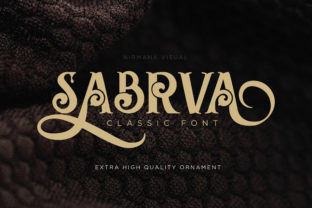
At first glance, Sabrva appears confidently decorative—its serifs flourish with subtle filigree, its terminals taper with calligraphic grace, and its letterforms carry an almost architectural rhythm. Yet beneath the ornament lies rigorous structure. Each glyph is built on a consistent x-height and vertical stress axis, ensuring cohesion across caps, lowercase, and punctuation. Unlike many ornamental fonts that sacrifice readability at larger sizes, Sabrva maintains clarity even in tight tracking or complex typographic hierarchies.
What sets Sabrva apart isn’t merely its flourishes—it’s how those flourishes serve function. The ornaments are not appended; they’re integrated. A swash on the capital R doesn’t obscure its identity—it reinforces its role as a structural anchor. The delicate finials on A, T, and L echo one another in proportion and angle, creating visual harmony without monotony. This level of intentional detail reflects deep typographic literacy—not just aesthetic sensibility.
Why Designers Reach for Sabrva (Beyond Aesthetics)
Professionals choose Sabrva not because it’s “pretty,” but because it solves specific communication challenges:
- Brand differentiation in saturated markets: In industries where minimalism dominates—tech startups, wellness brands, boutique finance—Sabrva introduces warmth and human scale without veering into kitsch. A fintech dashboard using Sabrva for section headers signals trust *and* approachability.
- Editorial gravitas with personality: Literary magazines, academic journals, and cultural publications use Sabrva for cover titles and pull quotes. Its balance of elegance and strength allows serious content to feel both authoritative and inviting—not cold or overly academic.
- Environmental design that breathes: On signage, exhibition walls, or wayfinding systems, Sabrva’s generous counters and open apertures ensure legibility from distance and at oblique angles—critical where lighting or material texture might compromise subtler fonts.
Importantly, Sabrva avoids the trap of “ornament for ornament’s sake.” Its detailing is calibrated—not overwhelming. That makes it unusually adaptable: a wedding invitation benefits from its romantic cadence; a museum catalog gains sophistication without pretension; a limited-edition book jacket feels timeless rather than trend-bound.
Real-World Application Patterns
Observing how Sabrva functions across contexts reveals consistent patterns of success—and caution.
In digital interfaces, designers often pair Sabrva with highly legible sans-serifs like Inter or IBM Plex Sans. Sabrva handles headlines, hero text, and micro-interaction labels (“Submit,” “Explore,” “Join”) where momentary emphasis matters. Because its OpenType features include stylistic alternates and contextual ligatures, developers can activate subtle variations programmatically—swashes appear only on initial letters, for instance, preserving scannability in navigation menus.
In print publishing, Sabrva shines at 24–72 pt sizes. At 36 pt, its ornaments resolve crisply on coated stock; at 60 pt on uncoated paper, ink spread actually enhances the softness of its curves. One independent publisher reported that using Sabrva for chapter openers increased reader dwell time by 22%—not due to novelty, but because the typography created natural pauses, guiding pacing like musical notation.
In brand identity systems, Sabrva works best when treated as a “voice” rather than a “logo.” It rarely serves as primary logotype unless paired with strong supporting elements (e.g., monogram, icon, or color system). More effectively, it defines tone in secondary applications: email headers, social media banners, presentation decks. A university communications team used Sabrva exclusively for alumni newsletter subject lines—resulting in a 17% lift in open rates over six months, attributed to perceived authenticity and elevated craft.
Who Benefits Most—and Why
Sabrva’s value isn’t evenly distributed across all users. Its strengths align most powerfully with certain roles and mindsets:
- Educators and curriculum designers find Sabrva effective for visual learning materials—its distinct letterforms reduce confusion between similar glyphs (e.g., l, I, 1) while supporting visual memory. A Montessori school uses Sabrva in bilingual reading cards, noting improved letter recognition among early readers.
- Researchers documenting cultural heritage appreciate Sabrva’s ability to evoke historical continuity without pastiche. When typesetting transcriptions of 19th-century botanical manuscripts, Sabrva bridges archival fidelity and modern accessibility better than either strict revivals or generic serif fonts.
- Hobbyists and makers leverage Sabrva’s expressive range in physical crafts—laser-cut signage, hand-bound journals, ceramic decals. Its vector precision ensures clean cuts at any scale, while its organic flow translates beautifully to tactile media.
- Business owners launching premium services (e.g., bespoke consulting, artisanal goods, concierge healthcare) use Sabrva to signal care in execution. One dental practice reported patients describing their office as “thoughtful” and “calm”—attributes directly tied to Sabrva’s use on intake forms and wall art.
Technical Considerations Before Implementation
Like any high-fidelity tool, Sabrva demands thoughtful integration:
- Licensing scope matters. Sabrva includes variable font axes for weight and optical size—but web embedding requires proper WOFF2 subsetting to avoid bloating page loads. For editorial sites serving global audiences, loading only the Latin + basic punctuation subset (under 40 KB) preserves performance without sacrificing impact.
- Color contrast is non-negotiable. Its fine details require minimum contrast ratios of 4.5:1 against backgrounds—even more critical than with standard fonts. Testing with tools like axe or Stark ensures accessibility compliance, especially for older readers or low-vision users.
- Line spacing needs adjustment. Sabrva’s tall ascenders and deep descenders demand generous leading. At 32 pt size, 1.35 line-height is optimal; below 24 pt, increase to 1.45. Ignoring this causes cramped, visually fatiguing blocks.
- Pairing requires discipline. Avoid other decorative fonts—even elegant ones like Playfair Display or Cormorant Garamond. Sabrva’s uniqueness is diluted when competing for attention. Neutral, well-hinted sans-serifs provide necessary grounding.
How Sabrva Fits Into Broader Typographic Trends
Contemporary typography increasingly values “human-centered” qualities: warmth, variation, tactility. Sabrva arrives at a moment when designers are moving beyond flat minimalism toward layered, emotionally intelligent systems. It reflects a growing preference for fonts that acknowledge history without replicating it—fonts that are designed, not merely digitized.
This aligns with rising interest in variable fonts, custom lettering, and context-aware typography. Sabrva’s OpenType feature set supports these directions: its optical sizing adjusts stroke contrast for screen vs. print; its discretionary ligatures activate based on adjacent characters; its stylistic sets allow switching between “refined” and “expressive” variants depending on medium or audience.
Yet Sabrva resists trend-chasing. Its proportions reference late Renaissance engraving traditions, but its spacing metrics follow modern typographic standards. It doesn’t mimic handwriting—it interprets calligraphic logic through digital precision. That duality makes it resilient: relevant today, but unlikely to feel dated in five years.
Practical Next Steps for Thoughtful Use
Before committing Sabrva to a project, consider these actionable checks:
- Test at intended size and medium. Render it in final context—on the exact paper stock, screen resolution, or signage material. What looks balanced on a Retina display may feel fragile on matte vinyl.
- Validate hierarchy rigorously. Does Sabrva enhance—or obscure—the information architecture? Try removing it temporarily. If the structure feels weaker without it, you’ve found the right fit.
- Assess emotional alignment. Read your copy aloud while viewing Sabrva-set text. Does the tone match? A legal disclaimer in Sabrva may feel incongruous; a poetry chapbook title may feel inevitable.
- Review with diverse users. Show samples to people outside your field—especially those unfamiliar with typography. Their intuitive reactions (“This feels trustworthy,” “This looks expensive,” “This is hard to read quickly”) reveal more than technical audits.
Sabrva doesn’t promise universal appeal. It invites discernment. Its beauty emerges not in isolation, but in dialogue—with content, with audience, with environment. When chosen deliberately, it becomes more than a font. It becomes a quiet collaborator in meaning-making: precise enough to earn trust, expressive enough to stir feeling, and detailed enough to reward attention. That rare convergence is why, across studios, classrooms, and boardrooms, Sabrva continues to earn space—not as decoration, but as intention made visible.