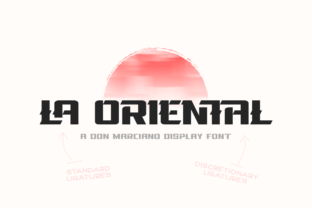
La Oriental: A Stylish and Bold Display Font for Impactful Design
La Oriental is a high-contrast, geometric display typeface designed for visual impact. It features sharp serifs, dramatic stroke modulation, and a confident, upright stance—characteristics that lend it a commanding presence at larger sizes. Unlike text fonts intended for extended reading, La Oriental is purpose-built for headlines, logos, posters, packaging, and other contexts where immediate recognition and stylistic distinction matter most.
Why Designers Consider La Oriental
Designers often seek typefaces that reinforce brand personality without relying on imagery alone. La Oriental appeals to those aiming for sophistication paired with assertiveness—think luxury fashion labels, cultural institutions, or editorial titles seeking gravitas. Its structure balances tradition (in its serifed form and vertical stress) with modernity (through clean geometry and tight spacing), making it versatile across contemporary visual languages.
Users may also be drawn to La Oriental for its distinctiveness in saturated design environments. With many brands defaulting to minimalist sans-serifs or retro-inspired scripts, a well-executed serif display font like La Oriental offers differentiation while maintaining typographic credibility.
Key Benefits of Using La Oriental
- Strong visual hierarchy: Its high contrast and generous x-height ensure legibility even at a distance or in constrained layouts.
- Stylistic cohesion: The font family typically includes multiple weights and widths, supporting consistent expression across applications—from bold signage to refined subheadings.
- Cross-medium adaptability: When used appropriately, La Oriental performs well in both print and digital displays, especially when paired with a neutral, highly legible text companion.
- Brand alignment potential: Its confident tone supports messaging around authority, heritage, craftsmanship, or curated experience—provided the broader design system reinforces that intent.
Practical Tradeoffs and Considerations
While La Oriental excels in display roles, it is not optimized for body text. Its contrast and tight letterfit reduce readability below ~24pt, particularly in long-form digital interfaces or small-print applications. Users expecting versatility across all typographic functions may find its scope limited without complementary text fonts.
Another consideration is contextual appropriateness. Because La Oriental carries strong stylistic weight, it can unintentionally dominate—or clash with—designs emphasizing approachability, playfulness, or minimalism. Its effectiveness depends heavily on surrounding elements: ample whitespace, restrained color palettes, and intentional layout decisions help prevent visual fatigue.
Licensing is also a practical factor. As a commercial font, La Oriental requires appropriate licensing for intended use—especially in web or app deployment, where variable font support and file size may affect performance. Always verify license terms for embedding, redistribution, or multi-user access before integration.
When La Oriental Is a Strong Fit
La Oriental works best when the communication goal centers on clarity, memorability, and tonal consistency—not subtlety or neutrality. It’s especially effective in:
- Branding systems where headline typography must reflect premium positioning (e.g., boutique hotels, fine art galleries, high-end cosmetics).
- Editorial design for magazine covers or section headers needing strong identity without competing illustrations.
- Environmental graphics, such as wayfinding signage or exhibition titles, where large-scale legibility and architectural harmony are priorities.
- Digital campaigns with short-form content—banners, social media headers, or email subject lines—where attention spans are brief and visual impact is critical.
In these cases, pairing La Oriental with a neutral, humanist sans-serif (e.g., Lato, Inter, or Source Sans Pro) for body copy creates functional contrast and maintains accessibility.
When Alternatives May Be More Suitable
If your project prioritizes flexibility across text and display roles, consider hybrid type families like GT Sectra or Recoleta, which offer matching serif and sans variants with shared proportions. These provide continuity without requiring separate font pairings.
For projects demanding warmth or informality—such as food branding, educational platforms, or community initiatives—a more organic serif (e.g., Playfair Display) or expressive sans-serif (e.g., Clash Grotesk) may better match audience expectations.
Similarly, if technical constraints limit font loading (e.g., performance-sensitive web apps), system fonts or lightweight web-safe alternatives may outweigh the aesthetic benefit of La Oriental. In such cases, evaluate whether the font’s contribution justifies added complexity.
Making an Informed Decision
To determine whether La Oriental aligns with your goals, begin by clarifying three things: your primary communication objective, your audience’s likely perception of typographic tone, and your technical implementation requirements.
Ask yourself: Does the message require immediacy and authority—or nuance and accessibility? Will viewers encounter the type at scale (e.g., on a storefront) or in dense interface elements (e.g., navigation menus)? Are you equipped to pair it effectively, or will it stand alone without supporting typographic layers?
Testing is essential. Render La Oriental in actual layout contexts—not just isolated mockups. Compare how it behaves across devices, background colors, and real content lengths. Evaluate not only aesthetics but also functional outcomes: Does it guide attention as intended? Does it remain legible under typical viewing conditions?
Finally, consider longevity. Display fonts trend quickly, and what reads as bold today may feel dated in five years. La Oriental avoids overt novelty in favor of structural confidence—making it relatively resilient—but no typeface is immune to shifting conventions. Prioritize timelessness over trendiness if your project aims for sustained relevance.
Conclusion
La Oriental is a purposeful tool—not a universal solution. Its value lies in specificity: delivering unmistakable presence where it’s needed most. For designers who understand its constraints and leverage its strengths intentionally, it offers reliable distinction and typographic authority. But its success hinges less on inherent qualities and more on thoughtful application: alignment with message, audience, medium, and execution discipline. Evaluating La Oriental alongside clear project criteria—not just visual preference—leads to more confident, effective typographic decisions.