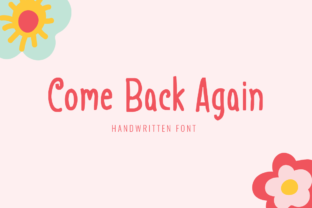
Come Back Again: A Whimsical Display Font
There’s a quiet magic in typefaces that feel hand-drawn but never sloppy—organic, expressive, and just confident enough to hold attention without shouting. Come Back Again is one of those rare display fonts that lands exactly where intention and charm meet: light in weight, warm in rhythm, and full of gentle personality.
It’s not a script—but it breathes like one. Not a serif—but it carries the soft authority of thoughtful typography. Designed with subtle irregularities in stroke width, slight variations in letter height, and delicate terminals that taper like ink drying on paper, Come Back Again invites closeness. It doesn’t dominate a layout; it welcomes people in.
Why Designers Reach for Come Back Again
For creators who value clarity *and* character, Come Back Again fills a specific niche: the sweet spot between legibility and expressiveness at larger sizes. Its x-height is generous, its spacing open and forgiving—even at 48pt or 72pt, words remain distinct and easy to parse. That makes it unusually versatile for a display face.
Unlike many whimsical fonts that sacrifice readability for flair, Come Back Again keeps lowercase ‘a’, ‘e’, and ‘g’ highly distinguishable. Uppercase letters have presence without rigidity—ideal for logos, event posters, or hero text where tone matters as much as message.
Real Projects, Real Applications
Here’s how different users are putting Come Back Again to work—not as decoration, but as intentional communication:
- Small business owners use it for café chalkboard menus and seasonal signage—its warmth reinforces hospitality without leaning into cliché “rustic” tropes.
- Educators and workshop facilitators apply it to handouts and slide headers to soften academic tone while keeping content scannable.
- Bloggers and newsletter writers pair it with a clean sans-serif (like Inter or Lato) for article titles—creating visual contrast that signals “this idea is worth pausing for.”
- Indie publishers choose it for poetry chapbook covers and limited-edition zine titles—where voice and intimacy matter more than mass appeal.
- Freelance designers build brand systems around it for clients in wellness, creative coaching, and handmade goods—industries where authenticity reads louder than polish.
Pairing It Thoughtfully
Good pairing isn’t about contrast for contrast’s sake—it’s about supporting hierarchy and mood. With Come Back Again, aim for balance:
- Use a neutral, highly legible sans-serif (e.g., Manrope, IBM Plex Sans, or Source Sans Pro) for body text. Their even rhythm lets Come Back Again shine without competing.
- Avoid other decorative or high-contrast fonts nearby—they’ll muddy the tone. One expressive face per composition is usually enough.
- When using color, lean into muted, natural palettes: olive + cream, slate + terracotta, or charcoal + oat. Bright neons can overwhelm its subtlety.
Adapting for Different Platforms and Formats
Web, print, and social each ask something different of a font—and Come Back Again responds well when you adjust expectations, not the type itself.
On websites, use it sparingly and purposefully: as an H1, a call-to-action button label, or a short testimonial quote. Load it as a variable font if possible (many modern versions support this), and always define fallbacks. Test rendering across browsers—especially Safari and older Android WebView—to ensure spacing stays open and letters don’t tighten unexpectedly.
In print, it performs beautifully at 24–96pt. For letterpress or foil-stamped pieces, request a slightly heavier cut or opt for the bold weight if available—light fonts can fade on textured stock. Always proof on the final paper type before full runs.
For social graphics, keep lines short. Instagram carousel headers and Pinterest pins benefit from its friendliness—but avoid stacking more than two lines of Come Back Again in a single image. Let white space do the work.
Making It Your Own—Without Losing Clarity
Customization works best when grounded in intent. Try these practical tweaks:
- Adjust tracking deliberately. Loosen it slightly (+20–40 units) for titles to enhance airiness; tighten minimally (–5–10) only if fitting tight horizontal space—never force it.
- Use case strategically. Title case often suits its rhythm better than all caps, which can flatten its organic flow. Reserve all caps for very short phrases (e.g., “YES”, “NEW”, “JOIN”).
- Add minimal texture—if needed. A faint paper grain overlay or soft drop shadow (1px, 10% opacity) can deepen its tactile feel—but skip effects that distract from shape or reduce contrast.
Who It Serves Best—and Why
Come Back Again isn’t for every brand or project—and that’s part of its strength. It serves people who understand that tone is built through consistent, thoughtful choices—not one-off flourishes.
It resonates most with audiences that respond to sincerity over slickness: readers of independent magazines, attendees of local maker fairs, students in creative writing courses, customers browsing small-batch skincare labels. In those contexts, its lightness reads as approachable, not unserious; its whimsy feels human, not childish.
If your goal is to signal care—care in language, care in design, care in how you show up for your audience—Come Back Again becomes more than a font. It becomes a quiet alignment tool.
A Final Practical Note
Before licensing or downloading, check what weights and language support come with your version of Come Back Again. Many releases include Regular and Bold, plus basic Latin characters—but if you need extended diacritics, Cyrillic, or OpenType features like stylistic alternates, verify compatibility early. Some foundries offer trial files; test them in your actual workflow—not just a preview window.
And remember: the most effective use of Come Back Again isn’t about how much you use it, but how clearly it supports what you’re saying. Let it introduce, invite, and emphasize—not explain, persuade, or replace strong writing.
When chosen with purpose and paired with restraint, Come Back Again does something rare: it makes typography feel like a shared breath—light, intentional, and quietly memorable.