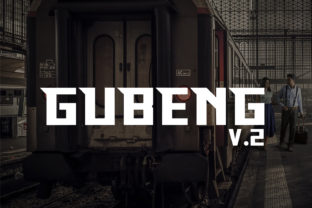
Gubeng V.2: A Modern Evolution of a Classic Typeface
Gubeng V.2 is the latest iteration of the Gubeng typeface family—a refined, updated version designed to preserve the structural integrity and readability of the original while introducing subtle refinements for contemporary digital and print use. It is not a complete redesign but a thoughtful evolution: adjustments to letter proportions, improved spacing (especially in variable-width contexts), enhanced hinting for screen legibility, and expanded language support—including extended Latin, Vietnamese, and basic Cyrillic coverage. These changes reflect real-world usage patterns observed since the release of the first Gubeng, particularly in UI design, editorial layouts, and branding systems requiring typographic consistency across devices.
Designers and developers evaluating typefaces often consider how well a font balances familiarity with freshness. Gubeng V.2 sits deliberately in that middle ground. Its roots in mid-century humanist sans-serif traditions lend it immediate legibility and visual warmth—qualities valued in long-form reading and interface text. Yet its updated metrics, slightly increased x-height, and more even stroke contrast give it a cleaner, more confident presence at smaller sizes and on high-resolution displays. That duality makes it relevant for teams weighing whether to refresh an existing brand system or begin a new project with a typeface that avoids both dated idiosyncrasies and overly generic neutrality.
One reason professionals explore Gubeng V.2 is its measured approach to modernization. Unlike many “next-gen” releases that prioritize novelty—sharp corners, extreme weights, or experimental optical sizing—Gubeng V.2 prioritizes functional improvement. For example, its Regular and Medium weights have been retuned to reduce visual fatigue in body text, while its Bold retains sufficient weight to serve as a clear hierarchy marker without dominating layout balance. The italic has also been redrawn with more consistent slant and improved character distinction—particularly beneficial for technical documentation where variables and emphasis need clear differentiation.
Benefits become most apparent in specific contexts. In responsive web design, Gubeng V.2’s optimized hinting and OpenType features—such as contextual alternates and discretionary ligatures—support robust rendering across browsers and operating systems. Its variable font implementation (where available) allows fine-grained control over weight and width axes without loading multiple static files—a tangible performance advantage for content-heavy sites. In editorial work, its generous counters and open apertures improve scannability in dense paragraphs, especially at 14–16px sizes common in digital magazines or news platforms. And for identity systems, its cohesive family structure—spanning seven weights and matching italics—offers enough range to define voice without requiring supplemental typefaces.
However, Gubeng V.2 is not universally optimal. Its humanist foundation means it lacks the geometric precision of fonts like Inter or IBM Plex Sans, which may be preferable for highly structured data dashboards or technical interfaces demanding absolute uniformity. It also does not include ultra-light or black weights, limiting options for dramatic typographic contrast in display settings. Users seeking extensive stylistic sets—ornaments, small caps, or historical forms—will find Gubeng V.2 intentionally restrained; it favors utility over ornamentation. Similarly, designers working with non-Latin scripts beyond its supported range (e.g., Arabic, Devanagari, or CJK) will need to pair it with complementary typefaces, as Gubeng V.2 does not extend into those writing systems.
Implementation considerations matter too. While Gubeng V.2 performs well in modern environments, legacy CMS integrations or older PDF workflows may not fully leverage its OpenType capabilities unless explicitly configured. Licensing is another practical factor: Gubeng V.2 is typically offered under a commercial license with tiered options for web, desktop, and app use—meaning teams must assess deployment scope before committing. Free alternatives exist, but they rarely match Gubeng V.2’s balance of language coverage, hinting quality, and typographic nuance. Evaluating cost against long-term maintainability—especially in multi-platform products—is therefore essential.
Gubeng V.2 tends to be a strong fit when the goal is continuity with intentionality. Consider it if you’re updating a brand that already uses the original Gubeng and wants to retain recognition while improving technical performance. It also suits projects where tone matters: education platforms, cultural institutions, or healthcare communications benefit from its approachable yet authoritative demeanor. Teams building design systems appreciate its predictable behavior across weight increments and its compatibility with common spacing scales (e.g., 4px or 8px baselines). If your workflow relies heavily on Figma or Adobe Fonts, verify that the version you access includes the full V.2 updates—some repositories still host older builds labeled ambiguously.
Conversely, alternatives may be worth deeper evaluation in certain cases. For strictly functional UIs—think enterprise SaaS dashboards or embedded device interfaces—Inter or Roboto Flex offer broader weight ranges, tighter vertical metrics, and more aggressive screen optimization. If multilingual support is central to your project (e.g., global e-commerce), Noto Sans or Source Sans Pro provide wider script coverage out of the box. For expressive branding with strong personality, fonts like Manrope or Space Grotesk introduce more distinct rhythm and texture—though often at the cost of paragraph-level neutrality. The decision hinges less on “best” and more on alignment: Does the typeface support your content strategy, technical constraints, and audience expectations without requiring workarounds?
Practical evaluation starts with testing—not just at headline size, but in context. Load Gubeng V.2 into your actual environment: render sample paragraphs with mixed punctuation, test line breaks in narrow columns, check contrast ratios against your background colors, and validate how it behaves alongside icons or inline code snippets. Compare it side-by-side with your current font and one alternative—not visually, but functionally. Ask: Does it reduce the need for manual kerning? Does it hold hierarchy clearly without bold overrides? Does it scale predictably from mobile to desktop? These observations reveal more than aesthetic preference; they point to maintenance effort over time.
Finally, consider longevity. Typefaces evolve, but major shifts carry migration costs. Gubeng V.2 was built to last—not as a trend-driven artifact, but as a stable foundation. Its updates address documented usability gaps rather than chasing stylistic shifts. That makes it a pragmatic choice for organizations planning multi-year digital roadmaps, where typography must remain legible, accessible, and adaptable—not just today, but as devices, standards, and user expectations continue to change.