Helios: A Quirky, Authentic Font for Designers Who Value Character
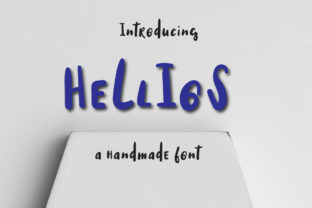
Helios stands out not because it tries to be everything, but because it commits fully to a specific kind of personality: warm, slightly imperfect, and unmistakably human. It’s a display font—designed primarily for headlines, logos, short quotes, and branding elements—built with hand-drawn sensibility and intentional irregularities. Unlike many modern sans-serifs that prioritize neutrality or geometric precision, Helios leans into asymmetry, variable stroke weight, and subtle organic shifts in letterform rhythm. That doesn’t mean it’s unpredictable in use—it’s carefully kerned and tested across common sizes—but it does mean it carries expressive texture right out of the box.
What Makes Helios Distinctive (Beyond Just “Fun”)
The word “fun” gets applied to fonts too easily—but with Helios, it’s earned through craft, not marketing. Its charm comes from deliberate choices: terminals that taper unevenly, rounded corners with slight variance, and letters like the lowercase a and g that echo vintage sign painting without mimicking any single historical style. There’s no forced nostalgia here; instead, Helios feels like a contemporary interpretation of how real people draw letters when they’re not constrained by grids or algorithms.
It includes both standard and stylistic alternates—like a swash capital H or a dotted i—that can be toggled depending on tone or context. These aren’t gimmicks; they’re functional variations meant to support hierarchy and voice. For example, using the alternate Q in a logo lockup adds visual interest without sacrificing legibility at scale. And unlike some highly decorated display fonts, Helios remains readable even at 24–36pt in print or on high-resolution screens—making it viable for more than just decorative flourishes.
Where Helios Fits Among Display Fonts
Display fonts fall along a spectrum—from ultra-refined and minimalist (think tightly spaced, monoline sans-serifs) to aggressively textured or distressed. Helios sits comfortably in the middle ground: expressive but controlled, distinctive but not distracting. It’s less rigid than fonts like Montserrat Black or Inter ExtraBold, which excel in clarity and scalability but offer little tonal nuance. It’s also less ornate or thematic than script-based display fonts or heavily illustrated typefaces, which can limit reuse across contexts.
This positioning gives Helios flexibility most display fonts lack. You’ll see it used effectively on café menus where warmth matters, in editorial features wanting visual punctuation, or in brand identities aiming for approachability without seeming childish. It works where you need personality *and* professionalism—not just one or the other.
Strengths in Practice
- Brand voice alignment: Helios supports brands that want to signal authenticity, creativity, or local character—especially those avoiding corporate sterility or overused design tropes.
- Print and screen resilience: Its open counters and generous x-height ensure legibility in both physical signage and digital banners—even when rendered at smaller sizes or under suboptimal lighting.
- Design efficiency: Because its quirks are baked in thoughtfully, designers spend less time manually adjusting spacing or adding custom flourishes to achieve a cohesive look.
- Pairing versatility: It pairs well with neutral text fonts like Lora, IBM Plex Serif, or even modest sans-serifs such as Work Sans—creating contrast without visual competition.
Tradeoffs to Consider
No display font is universally appropriate—and Helios is no exception. Its character becomes a limitation in certain settings. Long-form body copy? Not suitable. Technical documentation requiring strict consistency? Too idiosyncratic. High-contrast accessibility requirements (e.g., WCAG AA/AAA compliance for UI labels) demand more uniform stroke weights and predictable shapes than Helios provides.
Also, while its irregularities feel intentional to trained eyes, some stakeholders may misread them as “unprofessional” or “unfinished”—particularly in conservative industries (finance, legal, enterprise SaaS) where typography often functions as a quiet signal of reliability. In those cases, a more restrained option may serve communication goals better—even if it sacrifices some visual distinction.
When Helios Is the Right Choice
Helios shines when your goal is to reinforce a specific impression: friendly expertise, thoughtful craftsmanship, or grounded creativity. Imagine a small-batch bakery launching a new seasonal line—their packaging uses Helios for the product name and a clean serif for ingredients and origin details. The contrast communicates care in both flavor and form.
Or consider an independent bookstore curating a summer reading campaign. Using Helios for the headline “Stories That Stay With You” adds warmth and memorability without undermining the seriousness of the books themselves. It invites attention without shouting.
In digital contexts, Helios works well for hero section headlines, newsletter banners, or social media graphics—places where impact and tone matter more than dense information delivery. Its distinctiveness helps content stand out in crowded feeds, provided it’s sized appropriately and paired with sufficient contrast.
When Another Option May Serve Better
If your project requires extended reading—like a long-form blog post, academic white paper, or multi-step user interface—Helios isn’t built for that role. Its design intent is emphasis, not endurance. Similarly, if your audience includes many readers with low vision or dyslexia, fonts with higher uniformity, consistent letter spacing, and simplified forms (such as Open Dyslexic, Syntax, or Atkinson Hyperlegible) will support inclusion more effectively.
There are also scenarios where visual neutrality is strategic. A global tech company rebranding for broader market appeal might choose a versatile, internationally legible sans-serif over Helios—not because Helios is inferior, but because their priority is clarity across languages and cultures, not stylistic signature.
Making the Call: Fit Over Flash
Choosing Helios shouldn’t be about chasing trendiness—it should reflect intentionality. Ask yourself: Does this font help convey what we truly want people to feel or understand? Does it complement the message, or compete with it? Will it age gracefully alongside the rest of the brand system—or require constant reinterpretation to stay relevant?
Helios rewards thoughtful application. Used sparingly and deliberately, it adds dimension to otherwise flat layouts. Misapplied—say, stretched across every UI element or crammed into narrow columns—it loses its charm and begins to feel arbitrary. Like any strong voice, its power lies in timing, context, and restraint.
It’s also worth noting that Helios performs best when supported by solid typographic practice: appropriate line height, careful color contrast, and mindful sizing. Its authenticity isn’t a substitute for foundational design discipline—it enhances it.
Final Thoughts for Evaluators
If you’re comparing fonts for a real-world project, treat Helios as one candidate among several—not a default or a shortcut. Test it alongside alternatives in your actual layout, at realistic sizes, and with real content. See how it behaves next to photography, icons, and interface elements. Pay attention not just to first impressions, but to how it holds up after repeated exposure.
Fonts like Helios don’t solve problems on their own—but they can deepen resonance when aligned with purpose. They’re tools for expression, not magic wands for engagement. When your goals include warmth, individuality, and quiet confidence, Helios offers something rare: a display font that feels both handmade and thoroughly considered.