Ropefi: A Vintage Rope Texture Display Font for Authentic Retro Design
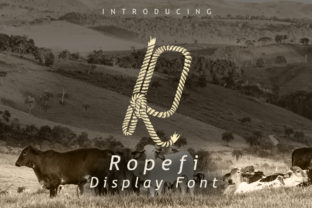
Ropefi isn’t just another display font—it’s a tactile, intentional design choice. Built with rope-inspired textures and hand-crafted irregularities, Ropefi delivers immediate vintage character without relying on filters or overlays. Its structure mimics twisted fiber: subtle grain, uneven stroke weight, and organic spacing that feels pulled from a 1940s signage workshop or a weathered carnival banner. That authenticity matters—not as decoration, but as functional visual language. When you choose Ropefi, you’re selecting tone, context, and continuity before the first word is laid out.
Where Ropefi Fits in Your Design Workflow
Ropefi belongs at the conceptual and structural stage—not as an afterthought, but as a decision point that shapes downstream choices. For marketers launching a heritage brand campaign, Ropefi often appears early in mood board assembly, helping align color palettes, photography style, and layout rhythm around a shared tactile reference. For educators designing printable history unit materials, it anchors thematic consistency: a font that signals “handmade,” “enduring,” and “human-scaled” before students read a single sentence.
It rarely functions alone. Ropefi pairs best with clean, highly legible sans-serifs (like Inter, Lato, or Montserrat) for body text—creating contrast that guides attention without competing. That pairing isn’t arbitrary; it reflects a practical workflow principle: use texture for hierarchy, clarity for comprehension. You’ll find this balance in restaurant menus (Ropefi for dish names, neutral font for descriptions), event posters (Ropefi for headline + date, simple type for venue details), or Shopify product pages (Ropefi for collection banners, system fonts for specs and CTAs).
Preparing to Use Ropefi Effectively
Before importing Ropefi into Figma, Adobe Illustrator, or Google Fonts (if hosted), consider three compatibility checkpoints:
- Format readiness: Ropefi is typically delivered as OTF or TTF. Confirm your platform supports OpenType features like ligatures or stylistic alternates—if those are part of the font’s design, enabling them unlocks extra nuance.
- Rendering behavior: Ropefi’s texture can soften at small sizes. Test it at 24px, 36px, and 60px on both desktop and mobile previews. Reserve it for headlines, logos, and short labels—not paragraphs or interface elements requiring fast scanning.
- Licensing scope: Check whether your license covers web embedding, app integration, or commercial merchandise. A freelance designer using Ropefi on a client’s e-commerce site needs different permissions than a teacher printing classroom posters.
Preparation also includes asset organization. Keep Ropefi’s files named clearly (e.g., Ropefi-Bold-Web.woff2, Ropefi-Regular-Desktop.otf) and store them in a project-specific /fonts/ folder—not just a global downloads directory. This avoids version confusion later, especially when collaborating or revisiting work months after launch.
Implementation Across Real Projects
How Ropefi integrates depends on your role—and your constraints. Here’s how it works across common scenarios:
For Small Business Owners Building Brand Identity
If you’re launching a craft brewery, Ropefi might define your logo lockup and tap handle labels—but only after you’ve settled on core brand values: approachability, tradition, local roots. Ropefi reinforces those values visually, but doesn’t replace strategy. Use it consistently across one or two high-impact touchpoints (e.g., storefront sign + bottle label), then step back. Overuse dilutes its retro impact and risks visual fatigue. Pair it with uncoated paper stock and muted earth tones to complete the sensory loop.
For Educators Creating Learning Materials
A middle school teacher building a Great Depression unit might apply Ropefi to timeline headers and primary source document titles—never student worksheets or rubrics. Why? Because Ropefi signals “this is historical artifact territory.” It cues students to shift mental framing before reading. To maintain accessibility, always pair it with sufficient contrast (at least 4.5:1 against background), avoid all-caps usage (which reduces legibility), and never stretch or skew the font—it breaks the rope texture’s integrity.
For Freelancers Managing Client Projects
Ropefi works best when introduced during discovery—not delivery. Show clients two versions of a homepage banner: one with Ropefi, one with a neutral alternative. Ask which better communicates “hand-built,” “time-tested,” or “community-focused”—whatever their stated goal is. This turns typography into a collaborative decision, not a stylistic imposition. If the client chooses Ropefi, document usage rules in your brand guidelines: size ranges, allowed weights, prohibited contexts (e.g., no Ropefi in email subject lines or navigation menus). That prevents revision loops later.
Long-Term Usability and Quality Control
Ropefi’s strength lies in restraint. Unlike system fonts designed for universal legibility, Ropefi thrives in controlled environments. That means long-term success depends less on technical setup and more on disciplined application. Audit your Ropefi usage every 3–6 months: Is it still serving its original intent? Has repetition made it feel generic instead of distinctive? Does it still align with your current brand voice—or has your audience evolved?
Consistency isn’t about using Ropefi everywhere—it’s about using it predictably. If your blog uses Ropefi for post titles, keep that rule across categories and years. If your podcast cover art applies it only to the show name (not episode titles), honor that boundary. These small decisions compound into recognizable identity—something audiences recall not by name, but by feeling.
Efficiency gains come from smart templating. Build Figma components or Canva templates where Ropefi is pre-set at optimal sizes and weights, with locked layer styles. That eliminates guesswork during tight deadlines. Likewise, in CSS, define Ropefi as a custom font-family variable (--font-display: 'Ropefi', serif;) and apply it only to , , or —never globally. This keeps performance light and maintains typographic hierarchy.
What Ropefi Doesn’t Do—And Why That Matters
Ropefi won’t improve copywriting. It won’t fix poor layout spacing. It won’t compensate for weak color contrast or low-resolution imagery. Its value emerges only when paired with sound fundamentals: clear messaging, thoughtful composition, and audience awareness. Think of it like a well-worn leather strap on a tool belt—not the tool itself, but what holds purpose in place.
That realism separates effective use from decorative clutter. When Ropefi feels forced—say, applied to a SaaS dashboard header or a legal disclaimer—it creates cognitive dissonance. The texture says “slow down, lean in,” while the context demands speed and precision. Recognizing that mismatch is part of professional judgment. Sometimes the most strategic move is choosing not to use Ropefi—even if you own the license.
Ultimately, Ropefi serves process, not just aesthetics. It asks you to pause and consider: What feeling do I want this moment to carry? Who needs to receive it—and how much time will they spend with it? Where does authenticity matter more than efficiency? Answering those questions—not just installing the font—is how Ropefi earns its place in real work.