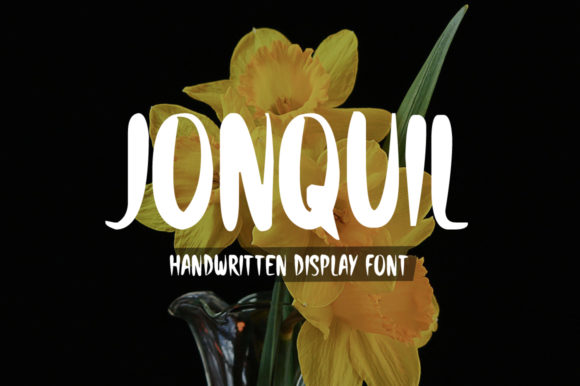
Jonquil: A Handwritten Display Font That Feels Like a Real Smile
Jonquil isn’t just another script font dropped into a marketplace—it’s the kind of typeface that makes you pause mid-scroll. Designed from scratch as a true handwritten display font, Jonquil captures the warmth, rhythm, and subtle imperfections of human handwriting without leaning into overly cursive or decorative territory. It’s confident but approachable, expressive but legible, personal but professional enough to hold its own in thoughtful design contexts.
Where Jonquil Fits Naturally (and Where It Doesn’t)
Think of Jonquil as your go-to when authenticity matters more than uniformity—when you want people to feel seen, not sold to. It shines brightest in projects where tone is half the message. A wedding invitation? Yes—especially for couples who value intimacy over formality. A small-batch coffee label? Absolutely. The hand-drawn “roasted daily” beneath a watercolor illustration feels grounded, human, and trustworthy. A boutique skincare brand launching a new line of herbal serums? Jonquil adds gentle authority—the kind that says “we made this with care,” not “we optimized this for conversion.”
It’s less at home in dense body copy, legal disclaimers, or multi-page reports. Jonquil is a display font, meaning it’s built for impact at larger sizes (24pt and up), not sustained reading. That’s not a limitation—it’s intentional design. Using it where it belongs keeps your work feeling intentional, not cluttered.
Real People, Real Projects: Who’s Already Loving Jonquil?
Creative freelancers love how quickly Jonquil elevates mood boards and pitch decks. One illustrator told us she uses Jonquil for client presentation headers—not because it’s flashy, but because it signals “this is handmade, thoughtful, and made for *you*.” It subtly shifts the conversation from transactional to collaborative.
Small business owners—especially those running local studios, bakeries, florists, or craft shops—find Jonquil bridges the gap between “I made this myself” and “I take this seriously.” A pottery studio in Asheville uses Jonquil on their seasonal workshop posters: “Handbuilding 101 • Sat, May 18.” The font doesn’t shout—it invites. And because it’s clean enough to pair well with simple sans-serifs (like Inter or Poppins), it scales gracefully from Instagram story text to printed flyers.
Educators and wellness practitioners also reach for Jonquil when they want warmth without whimsy. A yoga teacher in Portland uses it for her monthly newsletter subject lines (“Your Breath This Week”), while a literacy tutor incorporates it into printable phonics cards for early readers—its open letterforms and consistent x-height help reduce visual confusion without sacrificing personality.
Pairing Jonquil Thoughtfully (Without Overthinking It)
You don’t need a typography degree to use Jonquil well—but a little intention goes a long way. Its natural pairing partner is a friendly, neutral sans-serif: something with rounded terminals or gentle contrast, like Nunito, Manrope, or even the ever-reliable Open Sans. Avoid fonts with extreme geometric rigidity (think Montserrat Black or Futura Bold) unless you’re aiming for deliberate contrast—and even then, keep it minimal.
Color matters, too. Jonquil reads beautifully in deep charcoal, forest green, or muted terracotta—colors that echo natural materials and quiet confidence. Steer clear of neon brights or ultra-thin grays; they dilute its grounded energy. And if you’re printing, test it on uncoated paper first. Its slight variation in stroke weight gains texture and charm on matte stock—something glossy finishes can flatten out.
What to Consider Before You Commit
Jonquil includes standard Latin characters, numerals, and basic punctuation—but it doesn’t yet support extended language sets (like Vietnamese diacritics or Cyrillic). If your project targets multilingual audiences beyond English, Spanish, French, or German, double-check coverage before finalizing layouts.
It’s also a single-weight family—no light, bold, or italic variants. That’s part of its charm (it’s meant to be used as a statement, not a system), but it means you’ll rely on contrast with other fonts for hierarchy. For example: use Jonquil for headlines, then switch to a versatile sans-serif for subheads and body text. That combination gives you flexibility *without* visual noise.
And while Jonquil is highly legible at display sizes, avoid tight letter-spacing (tracking) below -20. Its natural flow comes from generous, breathing space between letters—not compression. One designer shared how tightening the tracking too much made her logo feel “stiff and apologetic.” Loosening it by 15 units brought back the ease she wanted.
When Jonquil Adds Quiet Confidence (Not Just Decoration)
Here’s what users consistently notice: Jonquil doesn’t distract—it directs attention *with* warmth. A nonprofit supporting rural literacy used it on their donor thank-you cards. Not on the full message—but just on the word “Thank you” at the top. Volunteers reported feeling “seen,” not processed. That’s Jonquil doing quiet, emotional work.
Another example: a freelance photographer specializing in family storytelling uses Jonquil only on the title page of her digital lookbooks—“The Hendersons • Spring 2024.” Nothing else. No borders, no flourishes. Just name, season, and Jonquil. Clients say it feels like the first line of a letter they’d want to open and read slowly.
It’s also becoming a favorite among indie authors designing their own book covers—particularly for memoirs, poetry collections, and essays about place, memory, or healing. Its lowercase “g” and “a” have soft, open shapes that suggest openness; its capital “J” has a gentle upward curve that feels like a quiet nod, not a flourish.
A Few Gentle Boundaries to Honor
Jonquil isn’t designed for accessibility-first interfaces—so skip it for primary navigation labels, form fields, or error messages. Its personality lives in moments of pause and emphasis, not function. Likewise, avoid layering it over busy backgrounds or textured photos unless you add a subtle drop shadow or solid color block behind it. Legibility should never be an afterthought.
And while it’s web-friendly (available in WOFF2 format with variable loading options), always declare fallback fonts in your CSS stack. Something like font-family: "Jonquil", "Nunito", "Segoe UI", sans-serif; ensures graceful degradation if the custom font fails to load—without losing tone.
At its core, Jonquil is about resonance over repetition. It won’t solve every typographic challenge—but when your goal is to make someone feel welcomed, understood, or gently inspired, it often lands exactly where you hoped it would.