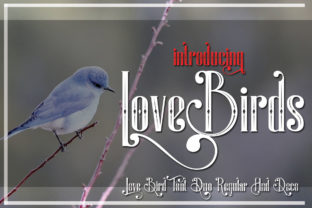
LoveBirds: A Romantic Display Font That Elevates Meaningful Design
LoveBirds isn’t just another script font—it’s a carefully crafted display typeface designed for moments that matter. With its flowing, elegant letterforms and subtle romantic warmth, LoveBirds excels in contexts where tone, emotion, and intention are as important as legibility: wedding invitations, boutique branding, editorial features, luxury product packaging, and heartfelt social media visuals. Its charm lies in balance—delicate enough to feel personal, structured enough to remain readable at larger sizes, and distinctive enough to stand apart from overused alternatives.
Why People Reach for LoveBirds (and Why It’s Easy to Misuse)
Designers and creators often choose LoveBirds because it promises sophistication and emotional resonance. That’s valid—but it’s also where assumptions begin to slip. Unlike versatile workhorse fonts (think clean sans-serifs or robust serifs), LoveBirds is intentionally specialized. It shines when used *sparingly* and *strategically*. Mistaking it for a general-purpose font—say, for body text, navigation menus, or dense paragraphs—is the most common misstep. At small sizes or in low-contrast settings, its fine strokes and connected forms can blur, weaken readability, and unintentionally signal informality or fragility where strength or clarity is needed.
Three Overlooked Realities Before You Download or License LoveBirds
- It’s not a web font by default. Many assume LoveBirds works seamlessly across websites. In reality, most versions are desktop-only OTF/TTF files. To use it reliably online, you’ll need a properly licensed web font version (WOFF2) and must embed it with appropriate CSS fallbacks. Skipping this step risks inconsistent rendering—or worse, invisible text on some devices.
- Licensing varies significantly by use case. A personal project license doesn’t cover client work, e-commerce banners, or app interfaces. Using LoveBirds in a logo without an extended license may expose your client—or your business—to legal risk. Always verify whether your intended use falls under the standard license or requires an upgrade (e.g., for unlimited impressions, merchandise, or SaaS platforms).
- Not all “LoveBirds” files are authentic. Free downloads from unofficial sites often distribute outdated, modified, or even malware-laced versions. These lack kerning pairs, OpenType features (like discretionary ligatures or swashes), and consistent spacing—undermining the very elegance LoveBirds is known for. Authentic LoveBirds comes only from trusted foundries or authorized resellers like Creative Market, MyFonts, or the designer’s official site.
How Poor Implementation Affects Real Outcomes
Using LoveBirds without checking context can quietly erode effectiveness. For example, a small business owner designing their own wedding stationery might set the entire RSVP card in LoveBirds—including the return address and deadline—in 10pt size. The result? Guests struggle to read essential details, increasing response time or causing missed dates. Similarly, a blogger embedding LoveBirds as a headline font without adjusting line height or letter spacing may find lines crowding together, reducing visual hierarchy instead of enhancing it.
These aren’t hypotheticals—they’re recurring pain points reported by designers who’ve inherited poorly executed LoveBirds projects. The cost isn’t always monetary; it’s in lost engagement, brand inconsistency, or rework hours spent correcting spacing, contrast, or licensing gaps after launch.
Better Choices: Practical Tips for Thoughtful Use
Start with purpose, not aesthetics. Ask: What emotion or message does this piece need to convey—and does LoveBirds serve that, or just decorate it? If the answer is “decorate,” reconsider. Here’s how to use LoveBirds well:
- Reserve it for high-impact, short-form content. Think headlines, quotes, monograms, or single-line callouts—not paragraphs, captions, or data tables. A real-world example: a café using LoveBirds for its seasonal menu header (“Spring Blossom Specials”), paired with a neutral sans-serif for dish descriptions. The contrast highlights warmth without sacrificing function.
- Test contrast and size rigorously. LoveBirds performs best on light backgrounds with dark, solid color fills—not light gray text on white, or reversed-out versions without stroke adjustments. Always preview at 100% zoom on both desktop and mobile. If letters touch or vanish at your intended size, scale up or switch to a supporting font.
- Pair intentionally—not arbitrarily. Avoid pairing LoveBirds with other decorative scripts or overly ornate serifs. Instead, choose grounded, clean companions: a humanist sans-serif (like Lato or Poppins) or a gentle geometric (like Montserrat Light). The contrast creates breathing room and directs attention where it belongs.
- Check OpenType features before finalizing. Authentic LoveBirds includes alternate characters, contextual swashes, and ligatures that add nuance—especially in words like “love,” “forever,” or “together.” Enable them in design software (via Glyphs panel or OpenType menu) rather than relying on basic character sets alone.
What to Verify Before You Commit
Before downloading or purchasing LoveBirds, take two minutes to confirm:
- The file includes both uppercase and lowercase glyphs (some early versions omitted full lowercase support).
- It contains at least basic punctuation and numerals—critical if you’ll use it for dates, prices, or contact info.
- The foundry provides clear documentation on language support (e.g., does it include accented characters for French, Spanish, or German names?).
- You’ve reviewed the End User License Agreement—not just the price—for permitted uses, attribution requirements (if any), and limitations on modification.
None of this diminishes LoveBirds’ appeal. In fact, respecting its design intent makes it more powerful. When used with awareness—of its strengths, boundaries, and proper context—LoveBirds becomes more than a pretty face. It becomes a quiet, confident voice in your visual language: romantic without being saccharine, luxurious without being distant, and memorable because it’s used with care.
If you’ve tried LoveBirds before and felt disappointed, chances are it wasn’t the font—it was the mismatch between expectation and application. With these considerations in place, you’re not just choosing a typeface. You’re choosing clarity, confidence, and connection—one thoughtful letter at a time.