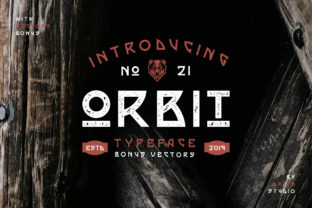
Orbit: A Spacey, Futuristic Display Font for Bold Visual Impact
Orbit is a display typeface designed for high-impact visual communication. It’s not intended for body text or long-form reading—rather, it excels where presence, personality, and thematic resonance matter most: headlines, logos, posters, digital banners, and interface accents. Its defining traits include geometric precision, generous letter spacing, sharp angular terminals, and a subtle sense of weightlessness—like typography engineered for low gravity. That “spacey” quality isn’t just aesthetic; it’s structural. Letters are built with clean vectors, consistent stroke contrast, and open apertures that enhance legibility at large sizes, even against dynamic backgrounds.
What Sets Orbit Apart From Other Display Fonts
Many display fonts rely on distortion, ornamentation, or exaggerated contrast to stand out. Orbit takes a different path: restraint paired with intentionality. Its boldness comes from proportion and rhythm—not decorative flourishes. Unlike retro-futuristic fonts that lean into 1970s sci-fi tropes (think chrome gradients or lens flares), Orbit avoids nostalgia. It feels contemporary because it prioritizes function: each character is optimized for clarity in motion graphics, responsive layouts, and variable environments—from dark-mode UIs to outdoor signage.
Its spacing system is calibrated for visual balance, not uniformity. Uppercase letters like A, M, and W maintain optical consistency without mechanical rigidity. Lowercase forms retain distinction without sacrificing cohesion—something many geometric sans-serifs struggle with at scale. This makes Orbit unusually versatile within its category: it reads as authoritative in a tech keynote slide, yet retains enough character to support creative branding in art installations or music visuals.
Fitness for Purpose: Where Orbit Delivers Strongest
Orbit shines when the goal is immediate recognition and tonal alignment—not subtlety. Consider these realistic use cases:
- Product launch campaigns for hardware, AI tools, or aerospace-adjacent services—where conveying innovation, precision, and forward momentum matters more than warmth or familiarity.
- Digital interfaces requiring strong visual hierarchy—such as dashboard headers, feature cards, or onboarding screens—especially where space is limited but impact is non-negotiable.
- Exhibition and event identity, particularly in science centers, design conferences, or immersive media experiences—where typography functions as part of the environment, not just information delivery.
- Editorial features in magazines or online publications covering emerging technology, speculative design, or futurism—where the font reinforces narrative tone without competing with imagery or copy.
In each scenario, Orbit contributes meaning—not just decoration. Its form supports the message: structured yet expansive, grounded yet unbound.
Tradeoffs and Practical Limitations
No display font works everywhere—and Orbit is no exception. Its strengths become constraints in certain contexts. Because it’s engineered for scale and contrast, small sizes (below 24px) often sacrifice legibility, especially in UI components like buttons or captions. Its generous x-height and tight internal counters don’t adapt well to narrow widths or tight line spacing, making it unsuitable for dense data tables, footnotes, or multi-column body text.
Also worth noting: Orbit’s distinct voice carries semantic weight. In brand systems aiming for approachability, tradition, or organic authenticity—think artisan food labels, wellness apps, or educational platforms for younger audiences—it can feel overly clinical or detached. It doesn’t convey empathy, playfulness, or heritage by default. That’s not a flaw; it’s a design decision baked into its architecture.
Another consideration is language support. While modern releases typically cover Latin-based scripts comprehensively—including extended diacritics for Central and Eastern European languages—support for Greek, Cyrillic, or non-Latin writing systems varies by foundry and version. Always verify glyph coverage before committing to a multilingual project.
How Orbit Compares With Broader Typographic Categories
Orbit sits at the intersection of geometric sans-serif and futuristic display genres—but it avoids the extremes of either. Compared to classic geometric faces like Futura or Avant Garde, Orbit introduces more nuanced stroke modulation and less rigid symmetry, lending it greater dynamism without losing structure. It’s less austere than ultra-minimalist options and less ornamental than expressive variable fonts with dramatic axis shifts.
Within the “futuristic” category specifically, Orbit distinguishes itself through usability. Some fonts in this space prioritize novelty over function—using irregular baselines, fragmented letterforms, or experimental spacing that limits real-world application. Orbit opts instead for disciplined innovation: every deviation from strict geometry serves a legibility or rhythmic purpose.
When evaluating alternatives, consider not just visual similarity but functional alignment. A sleek monospace might evoke coding or terminal interfaces—but lack Orbit’s spatial openness. A rounded, friendly sans may improve accessibility in UI—but won’t carry the same conceptual weight for a quantum computing initiative. The right choice depends less on trendiness and more on whether the font advances the communication goal—or merely decorates it.
Implementation Considerations for Designers and Developers
Using Orbit effectively requires attention to context—not just installation. On the web, it performs best as a @font-face resource served via modern formats (WOFF2), with appropriate font-display settings to avoid invisible text during load. Because it’s a display font, pairing it with a highly legible, neutral text face—like a well-hinted humanist sans or a robust serif—is essential for balanced typographic systems.
For motion or interactive use, Orbit’s clean vector paths translate smoothly to SVG or CSS transforms. Its consistent metrics simplify animation timing and scaling transitions. However, avoid applying heavy distortions or warping effects—the font’s strength lies in its integrity, not malleability.
Licensing is another practical factor. Orbit is typically offered under desktop, web, and app licenses—often with usage tiers based on pageviews or installs. Always review the license terms before integrating into client work or production environments. Some versions include variable axes (weight, width), while others are static. Variable versions offer finer control but require compatible rendering environments.
Making the Call: When to Choose Orbit—and When to Look Elsewhere
Choose Orbit if your priority is creating unmistakable visual identity in contexts where users scan rather than read slowly—where tone, timing, and technological resonance are as important as content. It’s ideal when you need typography that feels both engineered and expressive, precise yet imaginative.
Consider alternatives if your project demands:
- High readability at small sizes—for example, mobile app labels, form fields, or annotation layers.
- Emotional warmth or cultural specificity—such as community-focused nonprofits, hospitality brands, or regional storytelling initiatives.
- Extensive multilingual or non-Latin support beyond standard Western European languages.
- Dynamic text reflow across unpredictable containers—like user-generated content feeds or adaptive email templates.
Ultimately, Orbit isn’t about being “the best” font—it’s about being the right tool for a specific kind of job. Like selecting a specialized lens for photography or a particular compound for material science, choosing Orbit signals intention: you’re designing for impact, clarity, and forward-looking coherence—not just filling space.
Before finalizing, test it in your actual environment: on target devices, alongside real imagery and color palettes, at the sizes and weights you’ll actually use. Typography decisions gain credibility not from aesthetics alone, but from how they behave under real conditions.