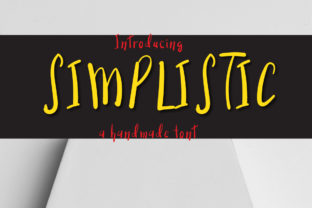
Simplistic: A Playful Display Font That Works With Your Process
Simplistic isn’t a tool for body text, spreadsheets, or legal disclaimers. It’s a bold, kooky display font—designed to stand out, spark attention, and add personality where clarity and impact matter most. Its uneven strokes, exaggerated curves, and cheerful irregularity make it feel handmade, human, and intentionally unpolished. That’s not a flaw—it’s the point. Simplistic fits into your workflow not as background infrastructure, but as a deliberate expressive choice: a visual punctuation mark that signals energy, creativity, or irreverence at exactly the right moment.
Where Simplistic Fits in Real Workflows
Think of Simplistic as a strategic accent—not a default. It thrives in moments where you’re shifting tone, highlighting contrast, or inviting emotional engagement. You wouldn’t use it for an internal project brief, but you might deploy it in the hero section of a product launch landing page to signal that this offering breaks from convention. You wouldn’t set a syllabus in Simplistic, but you could use it in the title slide of a workshop designed to challenge assumptions about learning itself.
Its role emerges most clearly when mapped against three phases of work: before, during, and after.
Before: Clarifying Intent and Setting Tone
Early in planning—whether you’re sketching a brand identity, outlining a presentation, or drafting social campaign assets—Simplistic helps test tonal alignment. Drop it into a mood board alongside color swatches and image references. If it feels jarring or mismatched, that’s useful data: it reveals a gap between your intended voice (“playful but professional”) and what’s actually landing (“chaotic without control”). Using Simplistic at this stage isn’t about final execution—it’s about calibration. It forces specificity. You can’t hand-wave “fun” when Simplistic is on screen; you have to decide whether “fun” means quirky, ironic, nostalgic, or mischievous—and whether that serves your audience.
During: Enhancing Visual Hierarchy Without Overcomplicating
Once you’re building—whether in Figma, Adobe Express, Canva, or even PowerPoint—Simplistic works best when paired with highly legible, neutral typefaces like Inter, Roboto, or Source Sans Pro. Use it strictly for short, high-impact elements: headlines, callout boxes, button labels, or animated text overlays in short-form video. Its bold weight and eccentric proportions mean it scales well, but only up to a point: keep it above 36px for web headers and avoid tight letter-spacing. Let it breathe. Pairing Simplistic with generous whitespace and restrained color palettes (two colors max, plus white or black) prevents visual fatigue and maintains professionalism—even while being weird.
One practical observation: Simplistic performs exceptionally well in motion. When animated with subtle bounce, stagger, or morph effects (via Lottie or lightweight CSS), its inherent quirkiness becomes kinetic rather than static—making it ideal for explainer videos, app onboarding screens, or interactive prototypes where user attention must be guided, not grabbed.
After: Reinforcing Identity Through Consistent, Limited Use
Post-launch, Simplistic’s value shifts from expression to recognition. If you’ve used it thoughtfully in key touchpoints—a podcast logo, a newsletter banner, or packaging for a limited-edition product—it begins functioning as a signature detail. But consistency here doesn’t mean ubiquity. It means applying the same rules every time: same weight (Bold only), same size range (never smaller than 28px in print, 32px on screen), same pairing logic (always with a clean sans-serif). That restraint turns idiosyncrasy into reliability. People start to associate that specific kind of bold playfulness with your work—not because it’s everywhere, but because it appears precisely where it matters.
Integration: What Works Well (and What Doesn’t)
Simplistic integrates cleanly with modern design systems—but only if treated as a controlled variable. It plays nicely with tools that support OpenType features (like variable fonts or stylistic sets), though its current release doesn’t include alternate glyphs. For developers, it’s web-ready via Google Fonts or self-hosted WOFF2 files, with no rendering quirks across Chrome, Safari, or Firefox. Just remember to declare fallbacks: font-family: "Simplistic", system-ui, -apple-system, sans-serif;
It does not integrate well with accessibility-first workflows when misapplied. Never use Simplistic for interface labels, form fields, navigation links, or anything requiring WCAG AA contrast or readability. Its decorative nature makes it unsuitable for long-form reading, multilingual layouts (diacritics and extended Latin characters are supported, but non-Latin scripts aren’t), or environments where screen readers prioritize semantic structure over visual flair.
Where it shines in integration is cross-medium cohesion. Because its personality is so distinct, using Simplistic in a printed event poster, then echoing its rhythm in a digital ad’s animation timing, then referencing its shape language in a custom icon set—it creates continuity without repetition. That’s how it supports branding: not by being repeated, but by being referenced.
Practical Implementation Tips
- Start small. Add Simplistic to one asset—like the headline on your next blog post thumbnail—then evaluate how it affects click-through rate or social shares. Measure before and after.
- Define usage rules early. Document when and where Simplistic is permitted (e.g., “Only in primary headlines under 10 words; never in body copy or data tables”). Share this with designers, marketers, and contractors.
- Test legibility in context. View Simplistic on mobile devices at actual reading distance—not just zoomed-in mockups. If users pause or tilt their head to decode it, simplify the application.
- Pair with intention. Avoid stacking multiple decorative fonts. Simplistic + one neutral sans-serif is enough. If your brand already uses a distinctive serif for quotes, Simplistic can serve as its energetic counterpart—not its competitor.
- Consider licensing scope. Simplistic is free for personal use, but commercial projects require a license. Verify permissions before embedding in client deliverables, SaaS UIs, or downloadable templates.
Long-Term Use: Sustainability Over Novelty
Fonts like Simplistic gain power through disciplined reuse—not constant reinvention. The more consistently you apply its constraints (size, weight, context), the more recognizable—and trusted—its presence becomes. Over time, it stops reading as “a fun font” and starts reading as “your fun font.” That shift is critical for creators building authority: it signals intentionality, not trend-chasing.
For educators, that means using Simplistic only in slide titles for icebreaker activities—not lecture notes. For entrepreneurs, it means reserving it for launch announcements and limited-time offers, not everyday email signatures. For publishers, it could anchor a recurring column header—“The Simplistic Take”—giving readers a predictable, light-hearted counterpoint to heavier analysis elsewhere.
The real efficiency gain isn’t in speed of implementation, but in decision compression. Once your team knows the Simplistic rule set, they stop debating “Should we use it here?” and start asking “How does it serve the message?” That saves hours across revisions, approvals, and asset handoffs.
Simplistic doesn’t streamline your process—it sharpens your choices within it. Its value isn’t in how many places you can use it, but in how clearly it helps you say, “This moment deserves attention—and a little joyful weirdness.” Used with purpose, it becomes less of a font and more of a functional cue: a tiny, bold, kooky lever that shifts perception, invites engagement, and reminds everyone involved—creator and audience alike—that clarity and charm don’t have to cancel each other out.