Chill Time: A Playful Display Font with Heart
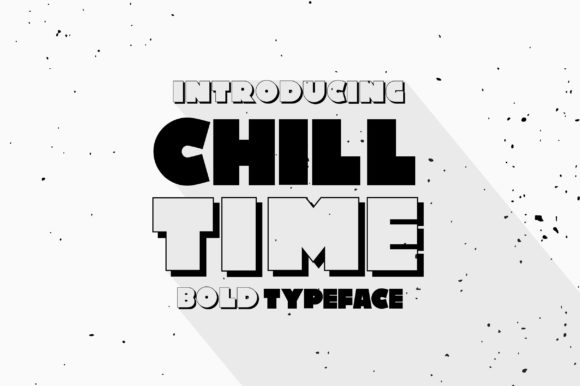
If you've ever scrolled through a design project and felt something was *almost* right—but missing warmth, personality, or that subtle wink of charm—you’re not alone. That’s where Chill Time steps in: not as a workhorse text font, but as a joyful, intentional accent—a display font that balances classic structure with genuine playfulness.
More Than Just “Cute”—It’s Thoughtfully Designed
Chill Time isn’t just rounded edges and bubbly letters. Its foundation is rooted in mid-century display typography—think friendly signage, vintage ice cream parlors, and hand-painted shop windows—but refined for modern clarity. Each glyph carries gentle asymmetry: the lowercase a tilts just enough to feel alive; the g has a soft, open tail; capital letters sit comfortably wide, never cramped. There’s no forced quirkiness—just consistent rhythm, generous spacing, and a subtle bounce in the baseline that invites the eye to linger.
What makes it especially useful? It’s highly legible at scale—even on mobile screens—and avoids visual fatigue. Unlike many “fun” fonts that sacrifice readability for novelty, Chill Time maintains strong character distinction (no confusing O and 0, I and l). It also includes full Latin-1 support, standard punctuation, numerals, and basic diacritics—enough for most English-language branding, social posts, and short-form print without needing fallbacks.
Where Chill Time Fits—Without Trying Too Hard
You don’t need a design degree to spot where Chill Time shines. It works best when intention matters more than neutrality—when tone is part of the message.
- Branding & Small Business: A local café launching weekend brunch specials? Chill Time on a chalkboard-style Instagram story adds authenticity—not gimmickry. A handmade soap brand using it for product labels communicates care and craft, not corporate polish.
- Educational Materials: Teachers building classroom posters or digital worksheets find Chill Time lowers perceived cognitive load for younger learners—and feels welcoming without infantilizing. One literacy coach told us she uses it for sight-word flashcards because students “recognize the shapes faster and smile while reading.”
- Digital Content: Bloggers highlighting key takeaways, podcasters designing episode thumbnails, or newsletter creators adding section headers—all benefit from its instant tonal lift. Used sparingly (headers only, not body text), it creates visual breathing room and reinforces voice.
- Print & Packaging: Wedding stationery, indie zines, festival merch, and artisanal food packaging all gain quiet confidence with Chill Time. It doesn’t shout—it invites closer looking. A small-batch candle maker reported a 22% increase in social saves after switching her product name treatment from a generic sans-serif to Chill Time + muted color blocking.
Real Use, Real Limits
Here’s what experienced designers tell us they wish they’d known earlier: Chill Time thrives in contrast. Pair it with a clean, neutral sans-serif like Inter, Lato, or even system fonts (San Francisco, Segoe UI) for body copy. That contrast does heavy lifting—Chill Time sets mood; the supporting font delivers information efficiently.
It’s not ideal for long paragraphs, dense reports, or accessibility-critical interfaces (like medical dashboards or legal disclosures). Its charm comes from restraint—not volume. And while it scales beautifully up to 120pt for posters or banners, avoid dropping below 24pt in digital contexts unless tightly kerned and well-spaced. At tiny sizes, some of its softer details (like the delicate curve on the lowercase e) can blur or disappear on lower-DPI screens.
A Few Practical Notes Before You Implement
First—test across devices. What reads as cheerful on a MacBook screen may feel slightly compressed on an older Android tablet. Always preview in context, not just in your font menu.
Second—consider licensing. Chill Time is available under both free-for-personal-use and commercial licenses. If you’re using it in client work, a SaaS dashboard, or printed merchandise for resale, verify the license covers your use case. Most reputable font vendors make this clear upfront—but double-checking avoids awkward conversations later.
Third—kerning matters. While the default spacing is thoughtful, headlines with combinations like “To” or “We” often benefit from slight manual adjustment. Don’t overcorrect—just nudge where letters feel visually unbalanced. A 5–10 unit shift is usually enough.
Why It Sticks With People (and Projects)
In a landscape saturated with hyper-minimalist or aggressively futuristic type, Chill Time offers something quietly rare: approachability with integrity. It doesn’t try to be everything. It knows its role—and executes it with consistency and warmth.
That reliability translates into real workflow benefits. Designers report spending less time debating font pairings for mood-driven projects. Marketers notice higher engagement on social creatives where Chill Time anchors the visual hierarchy. Educators say students reference materials more readily when headings feel human—not robotic.
And for solopreneurs and side-hustlers? It’s low-friction differentiation. You don’t need a custom logotype to signal personality. A well-placed Chill Time headline—on a Canva flyer, a Notion course outline, or a Substack welcome banner—immediately signals “this is made with care.” Not perfection. Not polish for polish’s sake. But care.
Try It Like a Tool—Not a Trend
Treat Chill Time like a favorite brush, not a filter. It won’t fix weak messaging or inconsistent branding—but it will amplify clarity, soften formality, and add sincerity where it counts. Use it to highlight values (“Hand-Poured,” “Locally Grown,” “No Algorithms”), not filler (“Click Here,” “Learn More”). Let it do what it does best: make people pause, recognize warmth, and feel seen—even in a glance.
Whether you're sketching a logo concept at 7 a.m., prepping slides for a parent-teacher night, or finalizing the cover for your first self-published ebook—Chill Time isn’t about escaping seriousness. It’s about choosing kindness in typography. And in today’s noise, that choice has weight.