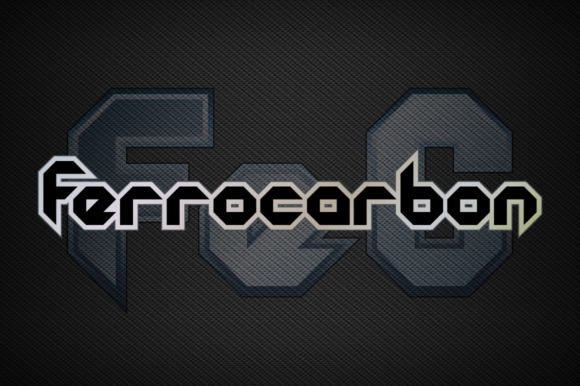
Ferrocarbon Family: The Sci-Fi Display Font That Commands Attention
Imagine a font that doesn’t just sit on the page—but hums with quiet intensity, like a starship’s core powering up. That’s the essence of the Ferrocarbon Family: a bold, futuristic display typeface engineered for impact, not subtlety. It’s not designed for body text or long-form reading. Instead, it thrives where presence matters most—logos, headlines, posters, digital interfaces, and immersive brand experiences rooted in science fiction, innovation, or forward-thinking vision.
More Than Just “Futuristic”—A Thoughtfully Crafted Identity
The Ferrocarbon Family earns its sci-fi reputation through deliberate design choices—not gimmicks. Its letterforms blend industrial strength with sleek precision: sharp angles meet subtle bevels; uniform stroke weights suggest structural integrity; and tight, controlled spacing evokes technical accuracy. The name itself hints at its character—ferro, referencing iron and resilience; carbon, symbolizing modernity, lightness, and adaptability. Together, they form a visual language that feels both grounded and otherworldly.
Unlike many “futuristic” fonts that rely on excessive distortion or alien glyphs, Ferrocarbon maintains exceptional legibility—even at large sizes. Its uppercase-heavy aesthetic is intentional, lending authority and clarity without sacrificing personality. It’s the kind of font that looks equally at home on a concept car’s dashboard interface as it does on a limited-edition vinyl record sleeve for an electronic music artist.
Who Benefits Most from the Ferrocarbon Family?
The Ferrocarbon Family isn’t for everyone—and that’s by design. Its power lies in specificity. Here’s who finds real value in it:
- Game developers and indie studios building sci-fi universes—whether for UI headers, faction logos, or cinematic title sequences;
- Brand strategists and designers launching tech-forward startups, AI tools, or hardware products that want to signal innovation without cliché;
- Event producers and festival organizers curating immersive experiences (think VR expos, synthwave concerts, or robotics showcases);
- Content creators producing YouTube thumbnails, Twitch overlays, or Patreon banners where instant recognition and genre alignment matter;
- Educators and science communicators designing exhibits, infographics, or presentation decks about space exploration, quantum computing, or sustainable engineering.
Real-World Uses: Where Ferrocarbon Shines (and Where It Doesn’t)
Let’s ground this in practice. A university’s aerospace engineering department used the Ferrocarbon Family for their annual “Frontiers in Propulsion” symposium branding—paired with clean sans-serif body text, it gave the event a credible, high-stakes energy that resonated with researchers and students alike.
Another example: a boutique audio gear company launched a new line of modular synthesizers named *NEXUS-7*. They chose Ferrocarbon for the product nameplate on each unit and in all promotional visuals. The font reinforced the product’s fusion of analog warmth and digital precision—no explanation needed.
But here’s what’s equally important: Ferrocarbon isn’t built for paragraphs. Its condensed proportions and strong geometric nature reduce readability below ~36pt. Using it for website navigation menus, blog intros, or mobile app labels would compromise usability—not enhance it. Think of it as a spotlight, not ambient lighting.
What Makes Ferrocarbon Stand Out in a Crowded Market?
In a landscape full of “cyber” and “neon” fonts, the Ferrocarbon Family distinguishes itself through restraint and versatility. Consider these strengths:
- Optical consistency across weights: From Light to Black, each variant preserves the family’s architectural DNA—no awkward compromises in contrast or rhythm;
- Smart OpenType features: Includes stylistic alternates, fractions, and lining/tabular numerals—practical touches for professional typesetting;
- Cross-platform reliability: Renders cleanly on macOS, Windows, and modern web browsers—including variable font support for responsive sizing;
- Distinct yet adaptable voice: It conveys futurism without leaning into retro-futurism (like 80s neon) or dystopian grit (like cracked concrete textures).
That said, it’s not universally flexible. Designers should know its limitations upfront:
- No true italic—only oblique variants, preserving its engineered aesthetic;
- Limited multilingual support (Latin-based languages only—no Cyrillic, Greek, or extended diacritics);
- Not ideal for accessibility-focused interfaces where high contrast and generous letter spacing are required.
Evaluating Fit: Does Your Project Need Ferrocarbon?
Before licensing or downloading, ask three practical questions:
- Is this a moment—not a medium? If your goal is a single, powerful impression (a logo, hero headline, exhibition banner), Ferrocarbon excels. If you need sustained typographic harmony across dozens of pages or screens, pair it wisely—or look elsewhere.
- Does your audience expect sophistication—not spectacle? Ferrocarbon avoids cartoonish tropes. It appeals to viewers who appreciate craftsmanship behind the cool factor—engineers, designers, gamers who love lore depth, and professionals tired of superficial “tech” aesthetics.
- Can you commit to thoughtful pairing? Ferrocarbon sings when balanced with a neutral, highly legible companion—like Inter, IBM Plex Sans, or even a refined serif such as Literata. Avoid clashing geometrics or overly decorative fonts that compete for attention.
One designer shared how she used Ferrocarbon for a climate-tech startup’s investor pitch deck: “We needed to communicate urgency and precision—not fantasy. Ferrocarbon gave our data visualizations and milestone headers weight and clarity, while our body text stayed warm and human. Investors told us the presentation ‘felt like the future we’re building’—not just a slide deck.”
Getting Started—Practical Next Steps
If Ferrocarbon resonates with your project’s goals, start small:
- Download a free trial version (most foundries offer one) and test it in your actual design environment—not just a preview panel;
- Mock up two versions of your key asset: one with Ferrocarbon, one with your current font. Compare at multiple sizes and distances (e.g., phone screen vs. desktop, thumbnail vs. full view);
- Run a quick legibility check: ask three people unfamiliar with your project to read aloud the Ferrocarbon headline—then ask what emotion or idea it evokes. Their answers will tell you more than any spec sheet.
Remember: great typography serves intention—not trends. The Ferrocarbon Family isn’t about looking “sci-fi” for the sake of it. It’s about giving voice to ideas that push boundaries, solve complex problems, and imagine what comes next—with confidence, clarity, and quiet power.
Whether you're naming a deep-space probe, launching a neural interface app, or simply refreshing your creative portfolio, Ferrocarbon offers something rare: a display font that feels inevitable, not imposed. It doesn’t shout. It resonates.