Hansel: The Vintage Display Font That Commands Attention—Without Saying a Word
There’s a quiet power in typography that doesn’t shout—it leans in, tilts its head slightly, and holds your gaze just a beat too long. Hansel does exactly that. It’s not another sleek sans-serif chasing minimalism, nor is it a nostalgic script trying too hard to feel “handwritten.” Hansel is something rarer: a vintage display font with an unmistakable personality—sophisticated, subtly unsettling, and utterly unforgettable.
What Makes Hansel Feel So Distinctive?
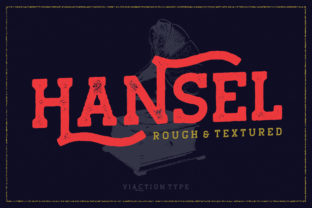
At first glance, Hansel looks like it stepped out of a 1930s bookplate or a weathered apothecary label. Its letterforms are tightly spaced, with delicate serifs, high contrast between thick and thin strokes, and a slight vertical compression that gives it presence without bulk. But look closer—the terminals taper with intention, the lowercase g and y curl with quiet confidence, and the uppercase A and M carry architectural weight. There’s restraint here, not rigidity.
That “slightly eerie” quality? It’s not horror-movie spooky. It’s the uncanny comfort of an old library where every shelf feels familiar—and yet, just beyond your peripheral vision, something shifts. Hansel evokes that feeling through subtle asymmetry and intentional irregularity: a serif that extends a hair longer on one side, a curve that breathes just a little more than expected. It’s controlled imperfection—designed to feel human, not algorithmic.
Where Hansel Truly Shines (and Where It Doesn’t)
Hansel isn’t built for body text. Don’t try to set a 2,000-word blog post in it. Its strength lies in impact, not endurance. Think of it as the typographic equivalent of a perfectly tailored blazer—worn for moments that matter.
- Branding for niche creative studios: A boutique design agency specializing in analog photography or experimental publishing might use Hansel for their logo—immediately signaling craft, history, and discernment.
- Film festival posters and indie album covers: Its moody elegance pairs beautifully with grainy textures, muted palettes, and hand-drawn illustrations.
- Luxury packaging for small-batch goods: Imagine Hansel embossed on a matte-black box of single-origin chocolate or artisanal incense—quietly luxurious, confidently different.
- Editorial headlines in print magazines: Especially in culture, fashion, or literary journals where tone and texture carry as much weight as content.
Conversely, Hansel loses its magic in contexts demanding neutrality or broad accessibility. It’s not ideal for SaaS dashboards, government forms, or multilingual interfaces where clarity across scripts is non-negotiable. And while it scales beautifully at 48pt and up, pushing it below 24pt risks losing its nuance—those fine serifs begin to blur, and its sophistication softens into ambiguity.
Pairing Hansel Thoughtfully
Typography is relational—and Hansel thrives when paired with intention. Its vintage sensibility doesn’t mean you must default to other “retro” fonts. In fact, some of its most compelling pairings are deliberately modern contrasts:
- With a crisp, low-contrast sans-serif (like Inter, Clash Grotesk, or Manrope): The clean geometry grounds Hansel’s flourish, creating visual hierarchy without competition.
- With a warm, monospaced typeface (such as IBM Plex Mono or Fira Code): Surprisingly effective for tech-adjacent brands leaning into analog aesthetics—think a developer tool with poetic documentation.
- With a restrained serif (like Charter or PT Serif): For editorial layouts where Hansel handles section headers and the companion font carries narrative weight.
Avoid pairing Hansel with other high-contrast or heavily decorative fonts. Two strong personalities in one layout rarely harmonize—they compete. Let Hansel lead. Give it space. Let it breathe.
Practical Considerations Before You Commit
Before dropping Hansel into your next project, ask yourself three questions:
- Does the audience understand—or appreciate—the tone it conveys? A Gen Z skincare brand targeting TikTok virality might find Hansel’s gravitas misaligned. But a slow-fashion label speaking to mindful consumers? Perfect resonance.
- Is the technical implementation sound? Hansel includes OpenType features like stylistic alternates and ligatures—but only if your platform supports them. Test thoroughly in your CMS, email client, or e-commerce theme. Some older systems render fallbacks poorly.
- Are you licensing it correctly? Hansel is a commercial font. Free downloads from unofficial sites often lack full character sets, contain malware, or violate usage terms. Always source from reputable foundries or authorized resellers. Licensing typically covers desktop, web, and app use—but check the specifics for your use case.
Also worth noting: Hansel’s character set is robust but not exhaustive. It supports Latin-based languages well—including extended diacritics for French, Spanish, German, and Polish—but doesn’t include Cyrillic, Greek, or Arabic glyphs. If your project serves multilingual audiences outside Western Europe, plan for graceful fallbacks or complementary typefaces.
Real-World Use Cases That Work—And Why
Consider a real example: a Brooklyn-based letterpress studio launched a limited-edition series of poetry broadsides. They chose Hansel for the poet’s name and title—set large, centered, in deep charcoal on ivory cotton paper. The body text? A modest 11pt Garamond. The result wasn’t just legible—it felt like holding a relic. Collectors didn’t just read the poem; they felt its weight.
Or take a digital example: a Berlin-based film curator used Hansel exclusively for navigation labels on their streaming platform’s “Cinematic Archives” section. Not for the homepage, not for buttons—but for the category headers (“Noir Shadows,” “Silent Echoes,” “Postwar Fragments”). Instantly, users understood this wasn’t Netflix. This was curation with care.
What ties these examples together isn’t nostalgia—it’s intentionality. Hansel works when the designer has already decided what emotion, memory, or atmosphere they want to evoke—and trusts the font to carry part of that load.
How to Test Hansel Without Overcommitting
Try this before finalizing: set three short phrases in Hansel at varying sizes (36pt, 60pt, 90pt) against your intended background color. Print them. Tape them to your wall. Live with them for 48 hours. Does the tone still feel right at 8 a.m. on a Tuesday? Does it hold up next to your brand’s photography or illustration style?
Then test readability in context. Paste a headline in Hansel into your live website mockup—not just Figma, but the actual environment where users will see it. Check contrast ratios. Scroll past it. Come back. Does it still command attention—or has it faded into background noise?
These aren’t bureaucratic hurdles. They’re respect—for the font, for your audience, and for the message you’re shaping.
Final Thought: Hansel Isn’t Just a Font. It’s a Statement.
In an age of algorithmically optimized UIs and generative design tools churning out safe, scalable type, choosing Hansel is quietly radical. It says: I value mood over metrics. I trust subtlety. I’m not trying to blend in—I’m inviting attention, on my own terms.
It won’t solve every typographic challenge. It won’t win awards for versatility. But when the moment calls for something that feels both timeless and quietly unnerving—something that lingers in the mind long after the page is closed—that’s when Hansel doesn’t just fit. It transforms.