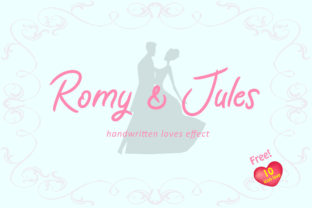
Romy Jules: A Romantic Display Font for Meaningful Design
When you need type that whispers elegance instead of shouting, Romy Jules steps in with quiet confidence. It’s not just another script font—it’s a carefully crafted display face designed to evoke warmth, sincerity, and timeless romance. Whether you’re crafting an invitation, refining a brand’s visual voice, or adding soul to a digital campaign, Romy Jules delivers personality without pretension.
What Makes Romy Jules Stand Out?
Romy Jules balances fluidity and structure. Its letterforms feature gentle swashes, soft terminals, and subtle contrast—enough to feel intentional, but never overwhelming. Unlike many decorative scripts that sacrifice legibility for flair, Romy Jules remains highly readable at larger sizes (24pt and up), especially in print and high-resolution digital contexts. The lowercase ‘g’, ‘y’, and ‘Q’ carry distinctive character without straying into novelty territory. And the included set of hand-drawn icons—think delicate hearts, floral motifs, and minimalist ribbons—extends its expressive range without requiring external assets.
It’s also well-spaced and kerned out of the box, which means less time adjusting tracking and more time focusing on message and mood. That attention to typographic detail reflects real-world usability—not just aesthetic appeal.
Where Romy Jules Fits Best (and Where It Doesn’t)
Romy Jules thrives where emotion and intention intersect. Think wedding stationery, boutique packaging, editorial features about love or self-expression, or even a heartfelt “thank you” page on a service-based business site. Its romantic charm works beautifully for brands rooted in care—therapists, yoga studios, artisanal bakeries, independent bookshops, or wellness coaches building trust through tone.
It’s less suited for body text, data-heavy dashboards, or interfaces requiring rapid scanning. You wouldn’t use Romy Jules for error messages, legal disclaimers, or navigation menus—and that’s by design. Its strength lies in emphasis, not utility. Knowing when *not* to use it is just as important as knowing when to reach for it.
Real-World Uses You Can Implement Today
- Small business branding: A local florist pairs Romy Jules for their logo with a clean sans-serif for supporting text—creating instant warmth while maintaining clarity on social bios, delivery notes, and thank-you cards.
- Educational materials: An educator designing a printable journal for teen emotional literacy uses Romy Jules for section headers (“What I’m Grateful For”, “My Quiet Wins”)—softening the tone and inviting reflection without infantilizing the content.
- Digital storytelling: A blogger documenting a slow-travel journey applies Romy Jules to quote callouts and chapter titles in long-form posts. Readers pause longer, absorb more—and share more often.
- Printed invitations & announcements: Wedding designers report higher client satisfaction when using Romy Jules for names and dates, especially alongside textured paper and muted color palettes. It feels personal, not generic.
Why the Icons Matter—More Than You Might Expect
The included icons aren’t decorative afterthoughts. They’re stylistically unified—drawn with the same rhythm and weight as the letters—so they integrate seamlessly. A heart icon next to “Love Notes” doesn’t compete; it completes. A tiny sprig beside “Botanical Workshop” reinforces theme without redundancy. These elements reduce reliance on stock graphics or inconsistent third-party icon sets, saving time and preserving visual cohesion across touchpoints.
In practice, this means faster mockups, fewer revision rounds with clients, and stronger brand continuity—even for solopreneurs managing their own design work.
Practical Tips for Using Romy Jules Well
Start simple. Try pairing Romy Jules with a neutral, highly legible sans-serif like Inter, Poppins, or Lato. Avoid other scripts or overly decorative fonts—they’ll clash rather than complement. Use it for headlines, quotes, logos, or short labels—not paragraphs.
Test contrast carefully. On light backgrounds, Romy Jules shines. On dark or busy textures, consider a slight stroke or subtle drop shadow—but only if needed. Over-engineering diminishes its natural charm.
Watch licensing. Romy Jules is typically offered with commercial use rights, but always verify the license covers your specific use case—especially for SaaS platforms, mobile apps, or embedded PDFs. Some versions allow web use via @font-face; others are desktop-only. When in doubt, check the download documentation—not assumptions.
A Note on Accessibility and Inclusion
Romy Jules isn’t intended for accessibility-critical contexts—like public signage, medical instructions, or government forms—where high legibility and WCAG compliance are non-negotiable. But that doesn’t limit its value. Used intentionally, it enhances emotional accessibility: helping audiences feel seen, welcomed, and understood. A therapist’s website using Romy Jules for session descriptions may signal compassion before a single word is read. That’s meaningful communication—not decoration.
How It Compares to Other Romantic Fonts
Romy Jules avoids the exaggerated flourishes of fonts like Great Vibes or the rigid formality of Allura. It sits comfortably between them—more relaxed than Allura, more grounded than Great Vibes. It also includes OpenType features like contextual alternates and ligatures, giving designers subtle control over rhythm and flow without manual glyph swapping.
Compared to free script fonts, Romy Jules offers tighter spacing, better language support (including extended Latin characters), and consistent stroke behavior across weights—critical when scaling for large-format prints or responsive layouts.
Final Thought: Let Type Serve Your Intent
Great typography doesn’t draw attention to itself—it draws attention to your message. Romy Jules does exactly that: it elevates sincerity, honors nuance, and supports human connection. Whether you're launching a new product, designing a keepsake, or simply choosing a font that feels like *you*, Romy Jules invites intention over impulse. It reminds us that in a world of speed and scale, some things—like thoughtful design—still benefit from a slower, more considered touch.
If your project carries meaning worth emphasizing, Romy Jules isn’t just an option. It’s a quiet, confident choice—one that says, “This matters.”